
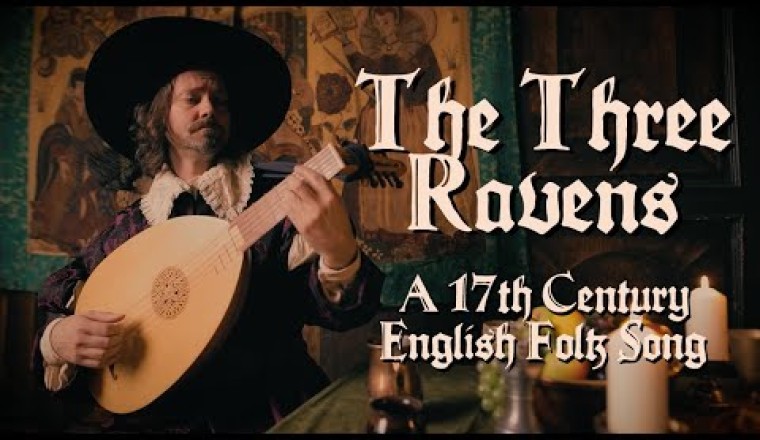

In the tapestry of English folk music, few songs are as starkly poetic and unsettling as “The Three Ravens.” First published in Melismata by Thomas Ravenscroft in 1611, this anonymous ballad paints a quiet, windswept scene of loyalty, death, and mourning in just a few stanzas—like a tragic play in miniature.
A Mournful Conversation of Birds
The song opens on a lonely field, where three ravens (or "corbies" in its Scottish counterpart) sit in a tree, debating where to find their next meal. As carrion birds, their feast is expected to be some recently slain knight—but what follows is no ordinary meal.
Instead, they describe a loyal retinue that keeps the knight’s body from being devoured: his hounds protect him at his feet, his hawks watch over him at his head, and most touching of all, a “fallow doe” comes to his side. The image is part fairytale, part myth—the doe, a metaphor for a devoted lover or perhaps a fairy figure, kisses his wounds and carries him away to a proper burial, under an “earthen lake.”
Symbolism and Subtext
The Three Ravens is drenched in allegory. The animals represent loyalty beyond death—servants, pets, and lovers refusing to abandon their master. The doe’s actions border on the magical, transforming this grim tale into something almost sacred.
Some scholars read it as a lament for the death of chivalry, or a romanticized vision of the ideal knight—one whose virtue is honored even in death. Others see it as a quiet nod to the futility of violence: even the victors are buried and forgotten, unless love remembers.
Musical Style and Legacy
The melody of The Three Ravens is slow, modal, and mournful—echoing the plainsong chants of medieval Europe. While it was first printed in the early 17th century, the song likely circulated orally long before that, a relic of older storytelling traditions where songs preserved memory more faithfully than stone.
Its Scottish cousin, “The Twa Corbies,” offers a darker, more cynical version of the tale: in it, the knight lies forgotten, his hawk and hound long gone, and his lover already with another man. The two versions contrast sharply, like daylight and dusk—making The Three Ravens seem even more tender by comparison.
From Pub to Parlour to Playlist
Over the centuries, The Three Ravens has been arranged and reimagined by composers, choirs, and folk singers alike. Its ghostly imagery and universal themes continue to resonate, appearing in everything from Renaissance festivals to contemporary folk albums.
Artists such as Steeleye Span, Loreena McKennitt, and even contemporary choral ensembles have given it new wings, each version adding its own color to the stark palette of the original.
Final Thoughts
The Three Ravens is not just a folk song—it’s a small, elegant elegy that asks us to consider how we treat the dead, how we remember the fallen, and what loyalty truly means. Whether sung in a smoky tavern, read from a dusty manuscript, or performed on a modern stage, it still stops us in our tracks with its quiet power.
In just a few lines, it holds a funeral, tells a love story, and mourns a way of life. What more could you ask of a song?