
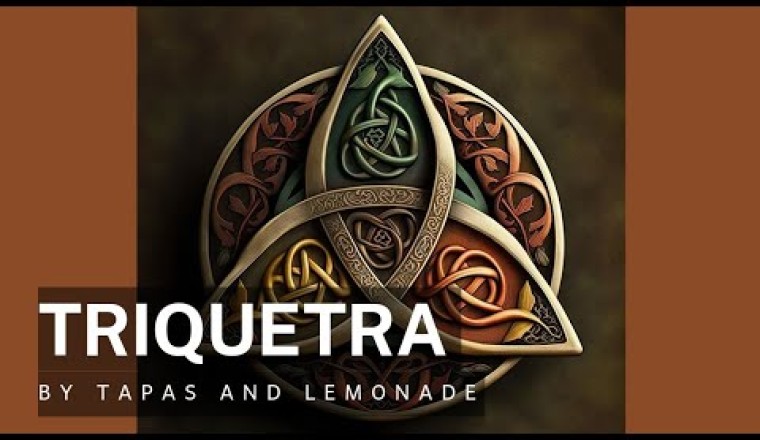

The triquetra is an ancient symbol with a rich and diverse history, spanning multiple cultures and meanings. Its name comes from the Latin word triquetrus, meaning "three-cornered." Below is a summary of its origins and uses across time and civilizations.
Origins and Early Use
Celtic and Norse Symbolism:
- The triquetra is often associated with ancient Celtic art and culture, appearing in carvings, jewelry, and manuscripts like the Book of Kells.
- In Celtic tradition, it symbolizes interconnectedness and continuity, often interpreted as representing the triple aspects of nature (land, sea, sky), the phases of life (birth, life, death), or spiritual concepts (mind, body, spirit).
Pre-Christian and Pagan Symbolism:
- The triquetra predates its adoption by Christianity and is thought to have roots in ancient Indo-European traditions. It was commonly used to symbolize tripartite deities or natural forces in pagan religions.
- In Norse culture, the triquetra is sometimes linked with Odin or Valknut, symbols representing the interconnectedness of life and death.
Christian Adoption
- During the early Christian period, the triquetra was adopted as a symbol of the Holy Trinity (Father, Son, Holy Spirit).
- It often appears in medieval Christian art and illuminated manuscripts, sometimes enclosed in a circle to emphasize eternity and unity.
- This appropriation helped integrate the triquetra into Christian contexts, especially in regions with Celtic heritage.
Medieval and Later Usage
- During the Middle Ages, the triquetra appeared in European heraldry and religious art, retaining both its Christian and older symbolic meanings.
- The symbol also became associated with alchemy and the occult, symbolizing triads like earth, water, and air or the stages of transformation.
Modern Symbolism
- Today, the triquetra is widely recognized in neopaganism, particularly in Wicca and Druidry, where it continues to represent trinities in nature and spirituality.
- In popular culture, it has appeared in various forms, such as in the TV series Charmed, where it symbolizes the "Power of Three."
- It is also used as a decorative motif, often with no specific religious or spiritual meaning, signifying unity and balance.
The triquetra’s enduring appeal lies in its elegant simplicity and its ability to encapsulate profound concepts of interconnection and eternity across different cultural and spiritual traditions.