

During this time, Hindu and Muslim artists and craftsmen from the northern regions of the Indian subcontinent worked with Iranian masters in the royal workshops to produce exquisite and unrivalled works ranging from paintings, illustrated manuscripts, brilliantly coloured carpets, and delicate textiles, as well as architectural pieces and vessels made of mother of pearl, rock crystal, jade, and precious metals.
The richly detailed, vibrant paintings and illustrated manuscripts, such as the Hamzanama, Akbarnama and Jahangirnama, recounted popular stories and documented court life. The pigments used in their creation were derived from mineral and organic sources.
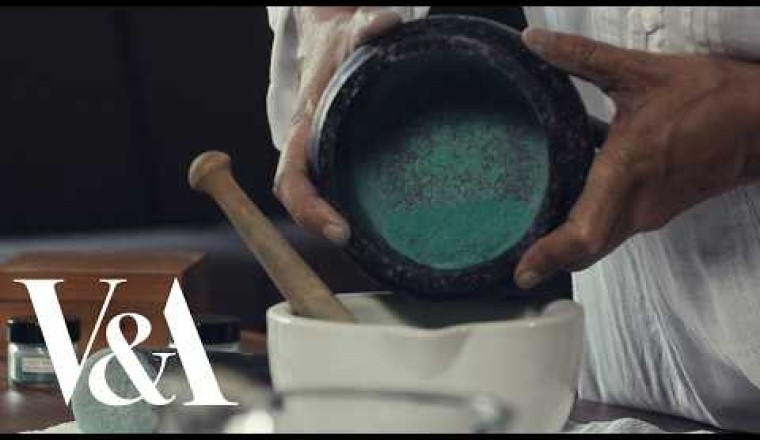
In this film, Anita Chowdry, visual artist and long-term researcher and lecturer in the Arts of the Book and painting in the Islamic world and Indian subcontinent, demonstrates the traditional, painstaking method of creating blue pigment from lapis lazuli and green pigment from malachite stones.
- 00:00 Introduction to Mughal painting
- 00:17 Meet Anita Chowdry, pigment expert
- 00:37 Pounding and grinding the malachite stone in a pestle and mortar
- 01:11 Removing impurities via levigation - ASMR alert!
- 02:29 Mulling the paste to make it finer
- 02:52 Lapis Lazuli - the colour of kings
- 04:05 Adding gum arabic and honey to make paint
- 04:39 Mulling until it swishes – very satisfying!
- 05:37 Painting with the finished pigments
- 06:05 Burnishing the lapis lazuli pigment with an agate stone
Find out more about the arts of the Mughal Empire: https://www.vam.ac.uk/articles/the-ar...