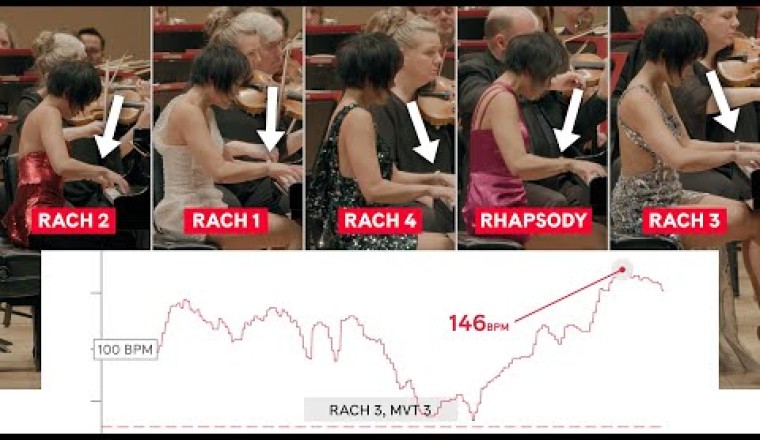

Throughout the performance, Wang—along with Nézet-Séguin, members of the orchestra, and concertgoers in attendance—wore devices to track their heartbeats.
Unprecedented and insanely demanding, Wang made history. These five pieces include two-and-a-half hours of music, 621 pages of score, and more than 97,000 piano notes.
To this day, Rachmaninoff’s virtuosic compositions captivate like few others, and these world-class artists ensured that the music was as heartily felt as it was technically astounding. Together, they answered a singular question: What happens when Rachmaninoff's music touches your heart?
- 00:00 - Introduction
- 01:07 - History of Sergei Rachmaninoff at Carnegie Hall
- 01:28 - Yuja Wang on Rachmaninoff
- 02:45 - Analysis of the performance data
- 08:32 - Yuja Wang's heartbeat before and after
- 08:55 - Yannick Nézet-Séguin's heartbeat data
- 10:03 - Synchronicity in Yuja Wang and Yannick Nézet-Séguin's heartbeat
- 11:37 - Case Studies
- 12:54 - Final Conclusions
Editor’s Note: This performance marked the first time in Carnegie Hall history that Rachmaninoff’s four piano concertos plus his “Rhapsody on a Theme of Paganini” were performed on a single program. It was not the first time in history this has ever been done.