

A Melody from the Mists of Time
Long before Mozart tickled the ivories or Beyoncé ruled the charts, a hymn was etched into clay in the ancient city of Ugarit (modern-day Ras Shamra, Syria), sometime around 1400 BCE. This ancient piece of music, known today as Hurrian Hymn No. 6, is the oldest surviving example of a written musical composition in the world. It’s not just a dusty artifact—it’s the earliest evidence we have that humans were writing down not only their words but their melodies, their devotion, their soul-sounds.
The Hurrians and Their Hymns
The Hurrians were a Bronze Age people who lived in the Near East, and while they’re not a household name, they had a sophisticated culture that included language, religion, and—you guessed it—music. In the 1950s, archaeologists unearthed a collection of 29 clay tablets at Ugarit. These tablets were inscribed with a series of hymns dedicated to Nikkal, the goddess of orchards. One tablet stood out from the rest: Hymn No. 6.
What’s On the Tablet?
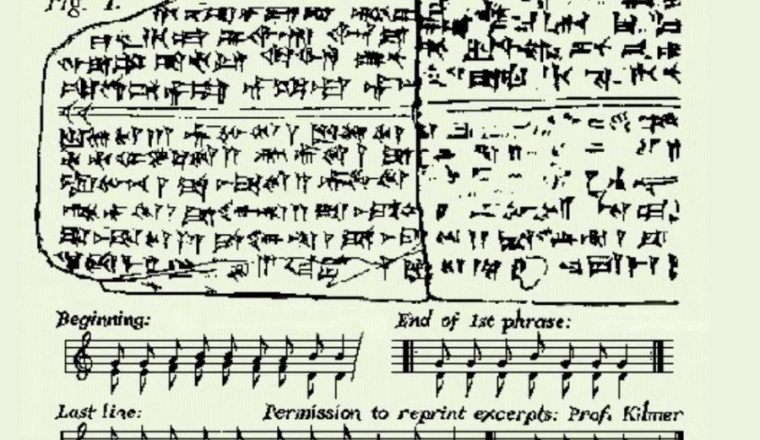
This little miracle of ancient songwriting is written in the Hurrian language using the cuneiform script. It's a hymn of praise and prayer to the goddess Nikkal, possibly requesting fertility for crops or children. The text includes both lyrics and instructions for a type of lyre accompaniment—yep, we’re talking full-on sheet music, Bronze Age edition.
The notation is proto-theoretical. It's not staff notation like we use today, but rather a system that combines words and symbols to indicate tunings and string plucking instructions for a nine-string lyre. The tablet even includes modal information—meaning it was aware of musical modes (precursors to our scales). These folks weren’t just banging on drums—they were composing with intention.
Can We Actually Hear It?
Now here's the catch: interpreting ancient notation is... let’s say... interpretive jazz meets archaeological puzzle. Several musicologists and composers have attempted reconstructions of Hurrian Hymn No. 6, and they all sound a little different. The most famous version was arranged by Dr. Anne Draffkorn Kilmer in the 1970s. It’s haunting, modal, and strangely timeless—imagine Enya performing in a Mesopotamian temple after a sandstorm.
You can find modern recordings online, often played on reconstructed lyres or vocalized with ancient-sounding scales. It might not make the Billboard Hot 100, but it’ll definitely hit you in the existential feels.
Why It Matters
This hymn isn’t just a quirky trivia fact for history nerds (although, let’s be honest, it’s a killer Jeopardy answer). It’s a living echo of our human desire to make sense of the world through sound. To express joy, to seek divine favor, to connect with one another across the invisible thread of melody.
Hurrian Hymn No. 6 reminds us that music isn't a modern invention—it’s been a sacred human impulse for millennia. Even when all we had were clay tablets and stringed instruments made from tortoise shells and sheep gut, we were singing our hearts out.
Fun Fact: The tablet is currently housed in the National Museum of Damascus, Syria. If it ever goes on world tour, we’re getting front row tickets.
So next time you stream your favorite track, tip your hat to the Hurrians. They started this whole “music” thing long before Spotify playlists and TikTok dances. And their song? It’s still echoing through the corridors of time, plucked gently from the silence of the ages.
A Few of the More Popular Renditions
Who can resist a chance to hear Hurrian Hymn No. 6 on a replica of an ancient lyre by “new ancestral” composer Michael Levy, who considers it his musical mission to “open a portal to a time that has been all but forgotten:”
I dream to rekindle the very spirit of our ancient ancestors. To capture, for just a few moments, a time when people imagined the fabric of the universe was woven from harmonies and notes. To luxuriate in a gentler time when the fragility of life was truly appreciated and its every action was performed in the almighty sense of awe felt for the ancient gods.
Ancient Lyre - First Written Melody - Michael Levy
And a haunting piano version, by Syrian-American composer Malek Jandali, founder of Pianos for Peace.
Malek Jandali Performs His Adaptation of “Hurrian Hymn no. 6”
Dr. Kilmer's rendition is one of several interpretations YouTuber Hochelaga samples in the below video.
While the original tablet gives specific details on how the musician should place their fingers on the lyre, other elements, like tuning or how long notes should be held, are absent, giving modern arrangers some room for creativity.
Below archaeomusicologist Richard Dumbrill explains his interpretation from 1998, in which vocalist Lara Jokhader assumes the part of a young woman privately appealing to the goddess Nikkal to make her fertile.
How did Babylonians build their musical system
Richard Dumbrill ft. Lara Jokhader