
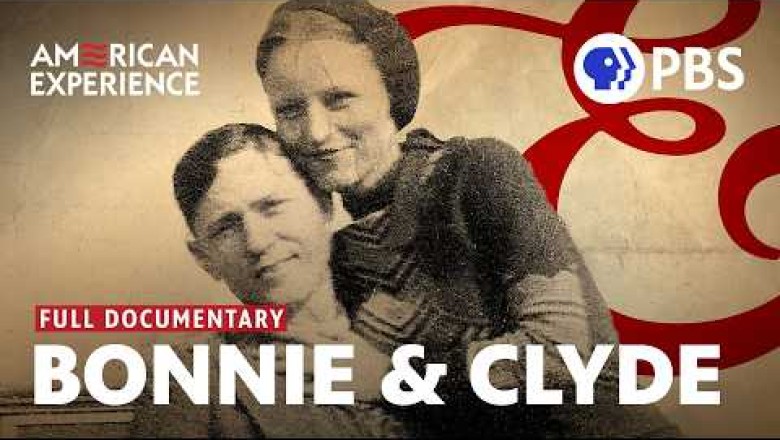

Few criminals in American history have been romanticized quite like Bonnie Parker and Clyde Barrow. Their names have become inseparable: Bonnie and Clyde, the young lovers speeding across Depression-era America, robbing banks, escaping the law and refusing to be separated even when death seemed inevitable.
It is a great story.
The truth was considerably darker.
For roughly two years, Bonnie and Clyde traveled with a changing collection of criminals known as the Barrow Gang, committing robberies, stealing automobiles, kidnapping people and becoming associated with a string of killings. By the time their journey ended on a Louisiana road in 1934, they had become two of America's most recognizable criminals.
PBS's American Experience: Bonnie & Clyde explores not only what the couple did, but something perhaps even more fascinating: how two relatively small-time criminals became American legends.
Before They Were Bonnie and Clyde
Clyde Barrow was born in Texas in 1909 into a poor farming family. His family eventually settled near Dallas in an impoverished area sometimes called the "Devil's Back Porch." Poverty surrounded him, and Clyde began committing relatively minor crimes as a teenager before graduating to automobile theft and more serious offenses.
Bonnie Parker, born in 1910, hardly seemed destined to become one of America's most famous outlaws. She was considered a good student and enjoyed writing poetry, singing and performing. She married Roy Thornton shortly before turning 16, but the marriage deteriorated and the couple separated. They never divorced.
Bonnie was still legally Thornton's wife when she met Clyde.
Bonnie and Clyde met in Texas in January 1930. Their relationship quickly became intense, but Clyde's criminal activity soon interrupted it. He was arrested, escaped with the help of a gun Bonnie had smuggled to him, was recaptured and eventually sent to prison.
After his parole in February 1932, Clyde returned to Bonnie—and the story that would make them infamous truly began.
The Barrow Gang
Popular culture often reduces the story to two lovers robbing banks together, but Bonnie and Clyde rarely operated entirely alone.
The Barrow Gang included several associates over the years, among them Clyde's brother Buck Barrow, Buck's wife Blanche, Raymond Hamilton, W.D. Jones and Henry Methvin.
Their crimes were also less glamorous than Hollywood would later suggest. Banks were only part of the equation. The gang robbed gas stations, grocery stores and other small businesses, sometimes escaping with surprisingly little money.
Life on the run wasn't glamorous either.
Bonnie and Clyde frequently slept in automobiles, ate whatever food they could obtain, bathed outdoors and drove enormous distances to stay ahead of law enforcement. They occasionally risked returning to the Dallas area for secret meetings with their families.
The glamorous outlaw fantasy was being created elsewhere—in newspapers and in the public imagination.
The Photographs That Created the Legend
One of the most important moments in the Bonnie and Clyde story happened in Joplin, Missouri, in 1933.
After a deadly confrontation with police, the gang fled so quickly that they left possessions behind. Among them were rolls of undeveloped film.
When the photographs were developed, America suddenly had extraordinary images of the fugitives.
One of the most famous showed Bonnie posing with a pistol and a cigar in her mouth. Other photographs showed the couple playfully pointing weapons at one another or posing beside automobiles.
The pictures were irresistible to newspapers.
Here was a young woman apparently rejecting virtually every expectation placed upon women of her era. She carried guns, traveled with criminals, posed with a cigar and remained beside her outlaw lover.
The images helped transform Bonnie Parker from a fugitive into a character.
The public began following Bonnie and Clyde almost as if their crime spree were a continuing adventure serial.
Outlaws During the Great Depression
Timing played an enormous role in their fame.
Bonnie and Clyde emerged during the Great Depression, when millions of Americans were struggling with unemployment, poverty, failed banks and distrust of powerful institutions.
The era produced a strange collection of celebrity criminals, including John Dillinger, "Pretty Boy" Floyd and "Baby Face" Nelson. Newspapers eagerly chronicled their crimes and escapes.
To some Americans, criminals who robbed banks could even be imagined as rebels striking back at institutions blamed for ordinary people's suffering.
Bonnie and Clyde fit perfectly into that mythology.
They were young. They were in love. They drove fast cars. They repeatedly escaped capture.
But they were not Robin Hood.
There is no evidence that Bonnie and Clyde were traveling the country redistributing stolen money to struggling families. Their crimes were committed primarily to keep themselves alive, mobile and free.
And people died.
The Violence Behind the Romance
This is the part of the story that decades of romantic storytelling can obscure.
The Barrow Gang was believed responsible for at least 13 murders as well as numerous robberies and kidnappings.
Their encounters with law enforcement became increasingly violent as the gang accumulated powerful weapons and authorities intensified their pursuit.
Clyde also carried a deep hatred for the Texas prison system following his own brutal experiences behind bars. In January 1934, Bonnie and Clyde participated in a raid on the Eastham Prison Farm that helped several prisoners escape, including Raymond Hamilton and Henry Methvin. A guard was killed during the escape.
By then, authorities were determined to end the Barrow Gang permanently.
Former Texas Ranger Frank Hamer was brought into the hunt.
The chase was approaching its final act.
The Ambush
Investigators eventually connected Bonnie and Clyde with Henry Methvin and his family in Louisiana.
Lawmen from Texas and Louisiana learned enough about the couple's movements to predict that they would travel along a rural road in Bienville Parish.
Before dawn on May 23, 1934, a posse concealed itself along the highway near Sailes, Louisiana.
Bonnie and Clyde approached in a stolen Ford V-8.
The officers opened fire.
The automobile was riddled with bullets, and Bonnie Parker and Clyde Barrow were killed.
Clyde was 25.
Bonnie was 23.
There would be no dramatic trial and no final prison sentence. Their years on the run ended in a matter of seconds beside a Louisiana road.
But their story was nowhere near finished.
Death Made Them Even More Famous
News of the deaths created a sensation.
Crowds descended upon the funeral homes where their bodies were displayed. Thousands reportedly came hoping to see the famous outlaws for themselves.
Even in death, Bonnie and Clyde were celebrities.
Their families buried them separately despite Bonnie's famous devotion to Clyde. The two people whose names would forever be spoken together did not receive the joint burial that legend might suggest.
Then popular culture took over.
Books, songs, television programs and movies repeatedly retold their story, with each generation reshaping Bonnie and Clyde according to its own ideas about rebellion, romance and authority.
The most influential interpretation came with the 1967 film Bonnie and Clyde, starring Warren Beatty and Faye Dunaway. Stylish, sexy and shockingly violent for its time, the film helped cement the image of the pair as doomed antiheroes.
That image remains powerful today.
Bonnie Parker: Outlaw or Myth?
Bonnie's actual role in the gang has generated particular fascination.
The famous photographs made her appear every bit the gun-toting gangster. Newspapers eagerly presented her that way.
Reality is more complicated.
Some violent crimes attributed to Bonnie at the time were based on questionable eyewitness accounts or sensationalized reporting. Her presence with the gang is beyond dispute, as is her willingness to remain with Clyde despite knowing exactly what their life had become. But determining precisely which violent acts she personally committed is considerably harder.
Her poetry offers another glimpse into how she understood—or perhaps dramatized—her own life.
Bonnie seemed keenly aware that she and Clyde were becoming characters in their own story. In her famous poem about the pair, she essentially predicted that their journey would end in death.
She was right.
Why Are We Still Fascinated by Bonnie and Clyde?
Nearly a century later, the fascination hasn't disappeared because their story contains almost every ingredient of an American legend: poverty, ambition, crime, automobiles, guns, celebrity, rebellion, romance and a violent ending.
There is also an uncomfortable tension at its center.
Strip away the photographs, movies and mythology and you find two desperately poor young Texans who made increasingly catastrophic decisions. Their lives on the road were dirty, exhausting and frightening. People were robbed, families were terrorized and law-enforcement officers and civilians died.
Yet the photographs remain.
Bonnie smiling beside Clyde.
Clyde leaning against a car.
Two impossibly young people staring back from another America, already seeming to understand that somebody might someday tell their story.
That is what makes PBS's American Experience: Bonnie & Clyde particularly compelling. The documentary looks beyond the legend to examine the people, the violence, the Depression-era culture and the media fascination that turned Bonnie Parker and Clyde Barrow into something larger than themselves.
The real Bonnie and Clyde survived on the road for only a few years.
The Bonnie and Clyde America created afterward have been on the run ever since.
The True Story of Bonnie and Clyde (An American Experience Documentary)