
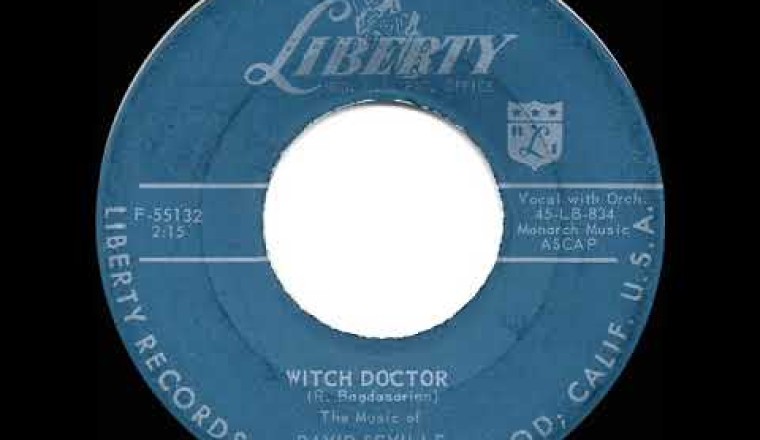

Few novelty songs have enjoyed the remarkable staying power of “Witch Doctor.” Released in 1958, the record transformed a lovesick man, some imaginary magical advice and a string of glorious nonsense syllables into one of the decade’s most unforgettable hits.
“Witch Doctor” was written, produced and performed by Ross Bagdasarian Sr., although the record was released under his professional name, David Seville. In other words, the songwriter and the man who made it famous were one and the same.
The song follows a man who seeks help from a witch doctor after failing to win the affection of the woman he loves. The doctor responds with a romantic remedy expressed through the famously infectious refrain, “Oo-ee-oo-ah-ah, ting-tang, walla-walla-bing-bang.”
Bagdasarian created the witch doctor’s peculiar voice by recording himself and manipulating the speed of the tape. Played back faster, his voice became high-pitched, frantic and instantly recognizable. The unusual effect helped propel “Witch Doctor” to number one on Billboard’s Top 100, the chart that preceded the Hot 100. It became one of 1958’s biggest records and reportedly helped rescue Liberty Records from serious financial trouble.
The Song That Led to Alvin and the Chipmunks
Although many people now associate “Witch Doctor” with Alvin and the Chipmunks, the original recording was credited only to David Seville. Alvin, Simon and Theodore had not yet been created.
David Seville was the professional name used by Ross Bagdasarian Sr., but it later became something more. When Bagdasarian created the Chipmunks, he turned David “Dave” Seville into a fictional character—the trio’s long-suffering manager, guardian and eventual adoptive father. Bagdasarian originally supplied Dave’s voice himself, essentially transforming his recording persona into a character within the Chipmunks’ world.
The connection was entirely deliberate. Bagdasarian expanded the sped-up vocal technique heard in “Witch Doctor” later that year when he recorded “The Chipmunk Song (Christmas Don’t Be Late).” That record formally introduced Alvin, Simon and Theodore, while David Seville became the exasperated father figure forever shouting Alvin’s name.
In that sense, “Witch Doctor” did more than inspire the Chipmunks’ unusual voices. It introduced David Seville, perfected the recording technique and laid the foundation for the entire franchise. The Chipmunks may not sing on the original recording, but nearly everything needed to create them was already there.
“Witch Doctor” in Movies and Television
The song and its later cover versions have appeared in several movies and television productions. Among the most notable examples are:
-
The Alvin Show featured an animated “Witch Doctor” musical segment in 1961.
-
Alvin and the Chipmunks used the song in its 1983 episode “The Chipmunks Story.”
-
In the 1987 animated film The Chipmunk Adventure, Miss Miller sings part of “Witch Doctor.”
-
The song appears in the 1991 coming-of-age movie My Girl, performed by Anna Chlumsky.
-
An Alvin and the Chipmunks version was included in Homeward Bound: The Incredible Journey in 1993.
-
DEVO recorded a wonderfully strange new version for The Rugrats Movie in 1998.
-
A modernized recording featuring Chris Classic and the Chipmunks appeared in the 2007 live-action film Alvin and the Chipmunks. Soundtracks
The Danish pop group Cartoons also turned “Witch Doctor” into an international dance-pop hit in 1998, introducing that incantation to another generation.
A Nonsense Chorus That Refused to Disappear
“Witch Doctor” was designed as lightweight novelty entertainment, but it became far more influential than anyone could have expected. Its studio trickery helped create Alvin and the Chipmunks, while its nonsense chorus became a permanent piece of popular culture.
More than six decades later, people may forget the verses or the singer’s name, but once that witch doctor begins offering his advice, nearly everyone knows what comes next.
Witch Doctor (Classic Version)