

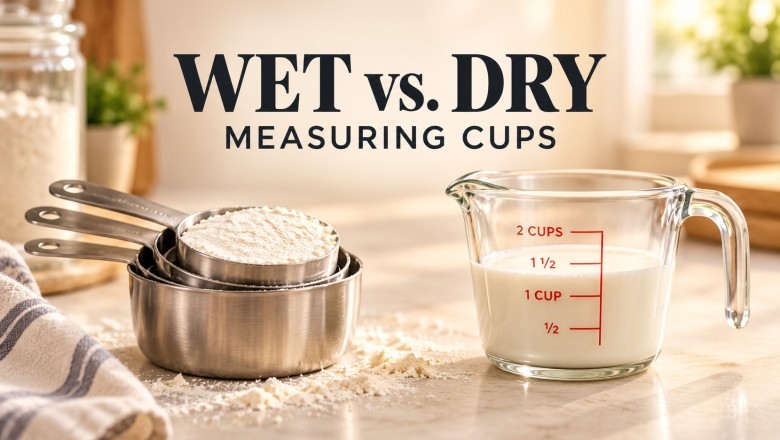

If you have ever measured flour in a glass pitcher or filled a little metal cup with milk, you are in good company. Plenty of home cooks use wet and dry measuring cups interchangeably. The kitchen police will not arrive. But there is a reason both kinds exist, and it matters most when you bake.
Do they measure different amounts?
No. A standard one-cup dry measure and the one-cup line on a standard liquid measuring cup represent the same volume. The difference is in how the cups help you measure that volume.
Dry measuring cups are made to be filled to the brim. You can spoon in flour or sugar, then sweep a straight edge across the top to remove the excess. A liquid measuring cup has markings below its rim, leaving space so you can carry and pour it without spilling. Set it on a level counter and read the measurement at eye level.
What goes wrong when you switch them?
Try measuring flour in a liquid cup. You must guess when the flour reaches the line, especially if it forms a mound. Shaking or tapping the cup to make the surface flat packs the flour down, so you may add more than the recipe intended. In a cake or batch of cookies, that extra flour can change the texture.
Now pour water into a dry cup. To measure a full cup, you have to fill it right to the edge. A little may spill as you pick it up or carry it to the bowl. That is less likely to ruin dinner, but it makes the measurement less dependable.
Is it ever okay to use the wrong cup?
Absolutely. If you are adding broth to a soup or flour to a sauce you will adjust by sight, a small difference may not matter. Use the cup you have and keep cooking.
Baking gives you less room to improvise. The balance of flour, liquid, fat, and leavening affects how doughs and batters behave. For those recipes, use dry cups for ingredients you can level off and a liquid cup for ingredients you pour.
For sticky ingredients such as honey or peanut butter, follow the recipe’s directions if it gives them. A dry cup can work well when you need to fill and scrape it clean; a liquid cup may be easier if the ingredient pours freely.
The easiest rule to remember
Fill and level dry ingredients. Pour and read liquids. If a baking recipe provides ingredient weights and you have a kitchen scale, weighing is even more consistent, particularly for flour.
So yes, using the cups interchangeably is normal. It is not automatically wrong. The two designs simply make different ingredients easier to measure accurately. Knowing when that accuracy matters lets you save the guesswork for recipes that can take it. Like when baking. It really matters when baking.
Is it Bad to Use Liquid Measuring Cups to Measure Dry Ingredients?