
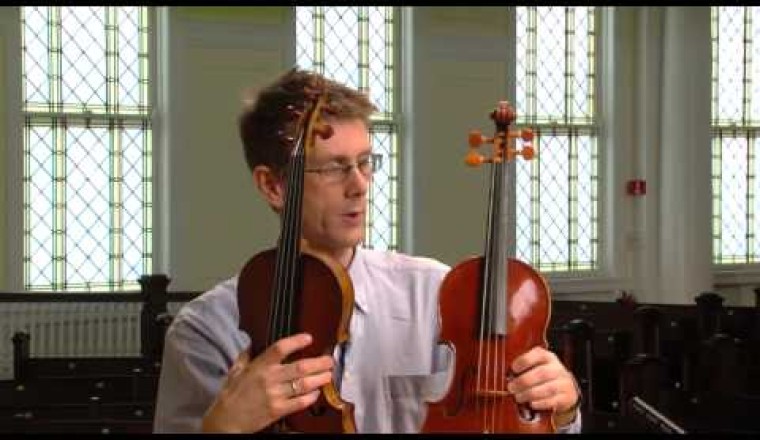

These differences stem from centuries of evolution in violin design, materials, and playing techniques, reflecting the changing tastes, acoustics, and musical demands of each era.
Structural Differences
-
Neck Angle and Length: The Baroque violin has a shorter, more shallow neck angle, often without a chin rest, which allows for a lighter, more delicate tension. In contrast, the modern violin's neck is slightly longer and angled back, increasing the tension on the strings for a more powerful sound.
-
Fingerboard and Bridge: The fingerboard on a Baroque violin is shorter and flatter, while the bridge is lower and less curved. The modern violin, by contrast, has a longer and slightly arched fingerboard and a taller bridge, enabling more intense string pressure, which supports the instrument's volume and projection.
-
Strings: Traditionally, Baroque violins were strung with gut strings, which produce a warm, rich sound but are less stable in tuning. Modern violins generally use synthetic or metal strings, which are more durable, stable, and capable of producing a louder, brighter tone.
-
Bow Shape: The Baroque bow has a convex curve and is typically shorter and lighter, which gives it a unique articulation, ideal for the dance-like rhythms common in Baroque music. The modern bow, on the other hand, is longer, heavier, and concave, which provides more sustained bowing and expressive dynamic range.
Sound and Playing Techniques
-
Sound Quality: The Baroque violin produces a softer, warmer sound with a rich resonance that suits smaller, intimate performance settings. Its sound is nuanced and delicate, emphasizing clarity and texture. The modern violin, in comparison, has a more robust sound that can project well in large concert halls.
-
Playing Technique: Baroque violinists generally use less vibrato, focusing on natural resonance and articulation rather than continuous vibrato. In contrast, modern violin playing often features sustained vibrato, which adds intensity and warmth to the sound, particularly in Romantic and later music.
-
Bowing Articulation: The Baroque bow encourages lighter, shorter strokes, which align well with the ornate and rhythmic style of Baroque compositions. The modern bow allows for a wider range of dynamics and longer, smoother phrasing, essential for Romantic and contemporary repertoire.
Historical Context and Use
The Baroque violin, prevalent in the 17th and 18th centuries, was tailored for music written during that period, including works by Bach, Vivaldi, and Handel. Modern violins became standardized in the 19th century to meet the demands of composers like Beethoven and Brahms, who required instruments that could deliver more volume and a broader tonal palette.
Despite these differences, both instruments are celebrated today: Baroque violins are used in historically informed performances, while modern violins dominate contemporary classical music. The contrast between the two illustrates not only the evolution of the violin but also the enduring adaptability and richness of the instrument across musical eras.