
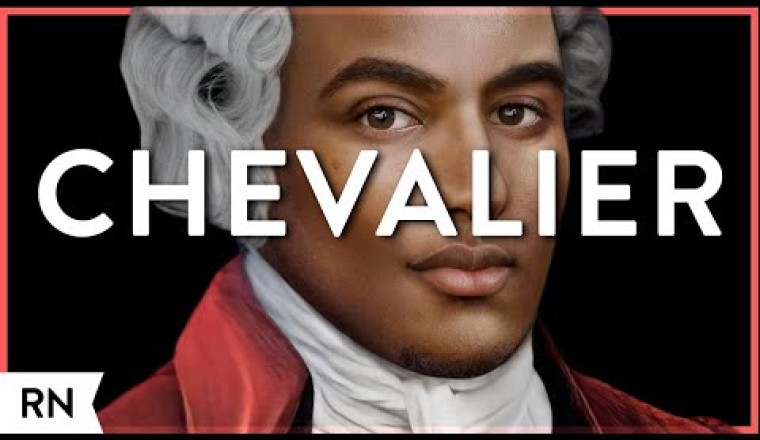

Born in 1745 on the island of Guadeloupe to a wealthy French plantation owner and an enslaved African woman, Bologne’s life defied every expectation of the time. He was Black, brilliant, and beautifully out of place in 18th-century France—and he made sure everyone knew it.
Sent to France at a young age, he quickly earned acclaim not just as a violin virtuoso and composer, but also as one of the greatest fencers in Europe. Imagine this: powdered wigs flying, sabers flashing, and in the midst of it all, Bologne—dashing, agile, and utterly unbothered. He was so skilled that he was appointed director of the prestigious Concert des Amateurs, one of the finest orchestras in Paris.
And his music? Oh, honey. Lush, elegant, full of fire and finesse. He composed symphonies, operas, string quartets, and violin concertos that could sing the soul out of you. His sound rivaled Mozart’s, and some even say Mozart "borrowed" a few tricks from the Chevalier’s scores.
Yet, as a man of mixed race in pre-revolutionary France, Bologne was never allowed to fully claim his crown. He was denied leadership of the Paris Opera (thanks, racism), and his name was nearly erased by history’s quill. But he didn’t stop. He fought in the French Revolution, led an all-Black regiment known as the Légion Saint-Georges, and remained defiantly dignified until his death in 1799.
Joseph Bologne, Chevalier de Saint-Georges, was more than just a composer or a swordsman. He was a revolution wrapped in brocade—an artist-warrior who danced on the edge of history and dared to compose a world that refused to see him.
Juicy Details
Grab your fan and clutch your pearls, darling—because Joseph Bologne, Chevalier de Saint-Georges, lived for the drama.
1. Mozart may have been his roommate (briefly!)
Yes, it’s whispered in the gilded halls of music history that when Mozart was struggling in Paris around 1778, he stayed in the same home where Saint-Georges was living. It’s not confirmed they bunked up like college bros, but they likely crossed musical swords. Now, here’s the kicker: some musicologists believe Mozart lifted elements of Saint-Georges’s compositions for his own works. Coincidence? Or a little "homage"? Let’s just say, if plagiarism were fashionable, Mozart wore it well.
2. He almost ran the Paris Opera—but the divas revolted
In the early 1770s, Saint-Georges was nominated to lead the Paris Opera—the pinnacle of musical prestige. But three white divas, all major stars of the company, refused to perform under "a man of color." They complained to Queen Marie Antoinette (who ironically was a fan of Saint-Georges), and the offer was quietly withdrawn. The racism was loud, but Saint-Georges stayed louder—in music and in action.
3. He led an all-Black regiment during the Revolution
While many aristocrats were running for their powdered-wigged lives, Saint-Georges was leading the Légion Saint-Georges, the first all-Black military unit in Europe. Think: violinist by day, revolutionary commander by night. And yes, they were fierce in battle—though internal politics and racial bias would eventually sabotage his military career too.
4. His music went missing for centuries
After his death, much of Saint-Georges’s music was suppressed or forgotten—buried under the weight of colonial erasure. Only in recent decades have his works been rediscovered and revived, often to shock and delight. Imagine hearing a violin concerto so divine you ask, “Who composed this?” only to learn it’s the man history tried to ghost.
5. He was a socialite, athlete, and all-around heartthrob
The man was gorgeous, charismatic, and dripping with style. Women adored him, men envied him, and even Marie Antoinette invited him to her inner circle. He fenced for kings, played violin for dukes, and composed music that still slaps today. Imagine Bridgerton, but real, and with more swordfights.
Most Famous Work
Joseph Bologne’s most famous composition is likely his Violin Concerto in D major, Op. 3 No. 1. It's a stunner—bright, virtuosic, and full of swagger. The opening movement practically struts, while the slow middle section sings with such lyricism you’d swear it was written for a romantic drama. It’s no wonder he was called Le Mozart Noir—though honestly, Mozart could’ve been called the Saint-Georges Light.
Other notable bangers include:
-
Symphonie Concertante in G major, Op. 13 – A beautiful dialogue between two solo violinists and orchestra, showing off his flair for balance and elegance.
-
String Quartet No. 1, Op. 1 – From one of the first published sets of string quartets by a composer of African descent.
-
Overture to L’Amant Anonyme – From his only surviving opera, The Anonymous Lover. It’s airy, witty, and totally stage-worthy.
His violin concertos, in particular, are where his soul sings loudest. They’re fiery, expressive, and demand serious technical chops—he didn’t write to show off, he wrote because he could.
Joseph de Bologne, Violin Concerto in D Major, Op. 3, No. 1
There is also a 2022 film by the name of "Chevalier" which you can catch over on Amazon. Why did they make a film about him? Other than being known as the "Black Mozart" he is also considered the first black musician in history.
Synopsis: Son of an African slave and a French farmer, Joseph Bologne, Chevalier de Saint-Georges, achieves an unthinkable position in society as a famous violinist, composer and fencer, in addition to experiencing an ill-fated love affair.
First 7 Minutes Of Chevalier: Violin Duel (Mozart vs Joseph)