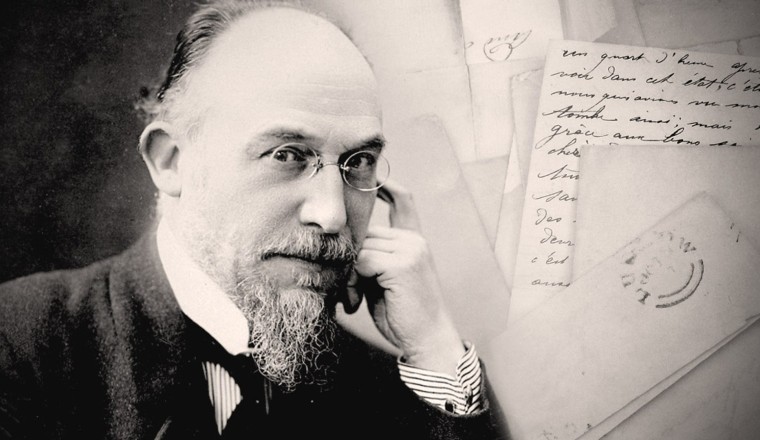

A composer, pianist, and cultural provocateur, Satie refused to follow the rules of his day, instead pioneering a dreamy, stripped-down sound that paved the way for minimalism, surrealism, and even ambient music. With a mustache that curled like a question mark and a wit as dry as vintage absinthe, Satie was a character just as compelling as his creations.
Born in Honfleur, Normandy, and raised in Paris, Satie studied at the Paris Conservatoire, where he was mocked for his unconventional technique. He later called the school “a kind of local lunatic asylum.” But what critics didn’t understand, future generations would revere: Satie was lightyears ahead of his time.
His best-known works—Gymnopédies (1888) and Gnossiennes (1890s)—are melancholy, haunting piano pieces that float on air. They broke with the lush, emotional drama of Romanticism and pointed toward a quieter, more introspective musical language. These compositions were so radical in their simplicity that Claude Debussy himself orchestrated some, recognizing Satie’s subtle genius.
Satie didn’t just write music—he wrote musical jokes, with absurd titles like Three Pieces in the Shape of a Pear and directions like “play like a nightingale with a toothache.” He collaborated with avant-garde giants like Jean Cocteau and Pablo Picasso, famously scoring the surrealist ballet Parade for Sergei Diaghilev’s Ballets Russes in 1917. It featured a typewriter, foghorn, and pistol in the orchestra. Naturally.
Though eccentric to the point of parody—he once claimed to eat only white foods—Satie’s influence is profound. He opened doors for composers like John Cage, Brian Eno, and Philip Glass. His music doesn’t demand your attention—it invites it, like a whisper in a storm.
When Erik Satie died in 1925, he left behind a room full of umbrellas, thousands of letters no one had read, and a musical legacy that’s still unfolding. He may not have followed the rules—but thank heavens he didn’t.
Gnossienne No. 1—that hypnotic little masterpiece that sounds like it drifted in from another planet wearing a silk robe and a vague sense of longing.
What made it so unique? Let’s break it down, but not too loudly—it’s a very sensitive piece:
🎵 1. No Time Signature or Bar Lines
Satie tossed the musical map out the window. Gnossienne No. 1 has no time signature and no bar lines, giving the performer an unusually high degree of rhythmic freedom. This wasn’t just rebellious—it created a sense of timelessness, like the piece is breathing at its own natural pace. It's less “marching to a beat” and more “wandering through a dream.”
🧭 2. Modal Mystery
Rather than traditional major or minor keys, Satie composed this piece in an exotic-sounding mode—think ancient, almost mystical scales. It’s possibly based on the Phrygian or Dorian mode, and some musicologists link it to the music of ancient Crete, hence the term Gnossienne, which may reference the labyrinth of Knossos.
✍️ 3. Emotive, Nonsensical Performance Directions
Satie didn’t just write music—he annotated it with surreal, poetic directions like:
- “Du bout de la pensée” (“from the tip of the thought”)
- “Sur la langue” (“on the tongue”)
- “Postulez en vous-même” (“question within yourself”)
These aren’t technical instructions—they’re emotional riddles, asking the performer to feel rather than calculate.
🌀 4. Repetition with Subtle Change
Satie uses repetition to lull you in, but it's never mechanical. Patterns twist ever so slightly, like ripples in still water. It feels improvisational, like a memory half-recalled. This kind of meditative structure would go on to inspire ambient composers and minimalists in the 20th century.
🌒 5. Atmosphere Over Virtuosity
No bombastic runs. No show-off flourishes. It’s not meant to impress—it’s meant to haunt you gently. The notes hang in the air like incense, and the silence between them is just as important as the sound.
In short, Gnossienne No. 1 is unique because it steps outside the rules and quietly asks, “What if music didn’t have to go anywhere—what if it could just... be?” And in doing so, Satie composed something eternally modern, endlessly mysterious, and utterly his own.
Take a listen....
What Makes Erik Satie’s Gymnopédie SO GENIUS?!