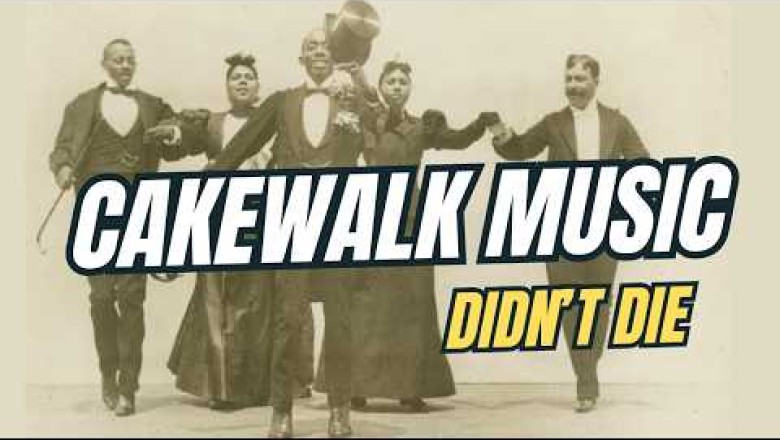

Long before ragtime swept America, jazz emerged from New Orleans, or country music found a home on radio, another sound was helping reshape American popular culture: Cakewalk music.
The Cakewalk began in African American communities during the era of slavery and eventually became one of the biggest dance crazes in the United States. It moved from Southern plantations to public competitions, minstrel shows and Broadway stages, filled major venues, crossed the Atlantic and even found admirers among European royalty.
Yet the history of the Cakewalk is far more complicated than the image of couples strutting dramatically around a dance floor.
Was the Cakewalk originally a parody of the elaborate dances performed by white plantation owners? Or were Black dancers taking elements of European dances—including the grand march, quadrille and cotillion—and transforming them into something distinctly African American?
The answer may be a little of both.
From Plantation Dance to National Craze
Accounts of the Cakewalk's earliest years vary considerably. Formerly enslaved people later described dances in which Black participants exaggerated the posture, gestures and formal movements they observed among white society. Some historians have consequently interpreted the Cakewalk as a subtle form of satire—a way of mocking the pretensions of the people who enslaved them.
But African American dancers were not simply imitating European traditions. They were transforming them.
Formal walking patterns, promenades and partner dances became infused with exaggerated steps, high kicks, dramatic poses, improvisation and individual personality. What emerged was something new.
Even the name has a wonderfully literal explanation. In many competitions, dancers performed for prizes, and one of those prizes could be a decorated cake.
The winning couple took the cake.
By the late 19th century, Cakewalk competitions had become enormously popular. Spectators gathered to watch couples compete through increasingly elaborate routines, and particularly talented dancers could become professional performers.
The Cakewalk eventually entered minstrel entertainment and vaudeville, creating an uncomfortable contradiction. A dance with deep African American roots was increasingly presented through an entertainment industry filled with racist caricature and blackface performance.
At the same time, Black performers used the Cakewalk as a route onto professional stages, helping introduce audiences to African American dance and musical traditions that would profoundly influence American entertainment.
What Did Cakewalk Music Sound Like?
The music accompanying the Cakewalk was generally lively, rhythmic and designed to encourage the exaggerated strutting movement of the dancers.
Its strong syncopation made it particularly important to the development of ragtime.
By the 1890s, published compositions frequently included "cakewalk" in their titles, and the musical style became intertwined with the rapidly growing ragtime craze. Composers began writing pieces specifically intended for Cakewalk dancing, while musicians borrowed rhythmic ideas from one another.
This is where the story becomes especially interesting.
The dance eventually faded.
The music didn't.
From Cakewalk to Ragtime
Cakewalk music occupied an important transitional space in American popular music. Its syncopated rhythms helped prepare American audiences for the explosion of ragtime around the turn of the 20th century.
Scott Joplin would become ragtime's most celebrated composer, but the musical world surrounding him had already been absorbing rhythmic ideas from African American dances, marches, folk traditions and Cakewalks.
The relationship between Cakewalk and ragtime became so close that the boundaries between them could sometimes become difficult to define.
A Cakewalk tune might become a ragtime number.
A ragtime composition might accompany a Cakewalk.
And both could eventually be transformed again by musicians who learned the melodies by ear rather than from printed sheet music.
That process allowed Cakewalk music to escape the ballroom entirely.
The Tunes That Refused to Disappear
Some of the most fascinating evidence of the Cakewalk's influence can be found in tunes that continued circulating long after the dance itself fell out of fashion.
Pieces associated with this musical world include "Whistling Rufus," "At a Georgia Camp Meeting," "Eli Green's Cakewalk," "Colored Aristocracy," "Red Wing," "Money Musk" and "Turkey in the Straw."
Not all of these tunes originated as Cakewalk compositions. Instead, they illustrate something even more interesting about American folk music: melodies constantly traveled between communities, musicians and musical styles.
A tune could be played for dancing, rearranged as a Cakewalk, published as sheet music, recorded by an early recording artist and later picked up by a fiddler or string band.
Each generation changed it slightly.
Rhythms shifted. Tempos changed. Instrumentation changed. Titles sometimes changed.
But the melody survived.
The Unexpected Connection to Old-Time Country Music
This is perhaps the most surprising chapter of the Cakewalk story.
A number of tunes associated with Cakewalk performance eventually became part of the repertoire of old-time fiddle and string-band musicians.
That means a musical tradition closely associated with African American dance history became intertwined with music that would later be marketed as rural "country" music.
The neat genre boundaries we use today simply didn't exist.
Black and white musicians heard one another. Fiddlers borrowed tunes. Traveling performers carried music from town to town. Minstrel companies spread melodies across the country. Sheet music publishers introduced songs to households thousands of miles away, and early recordings allowed regional styles to travel farther still.
American music was constantly mixing.
The journey from Cakewalk to ragtime to string-band music is another reminder that the histories of Black and white American folk traditions cannot easily be separated.
They developed alongside one another, frequently borrowing the same melodies, rhythms and techniques.
A Dance That Conquered the World
At the height of its popularity, the Cakewalk was not some obscure folk dance.
It was a phenomenon.
Large Cakewalk competitions attracted enormous audiences. Professional performers developed spectacular routines. The dance appeared in theatrical productions and eventually traveled overseas, where European audiences became fascinated with the latest American craze.
Early motion-picture cameras even captured Cakewalk performers, leaving us extraordinary glimpses of a dance whose origins predated the invention of cinema itself.
By the early 20th century, however, America's appetite for social dances was changing rapidly.
Ragtime dancing, the two-step, animal dances and eventually dances associated with jazz began replacing the Cakewalk. What had once been a national sensation gradually became a historical curiosity.
But its musical DNA had already escaped.
The Cakewalk Never Completely Went Away
The Cakewalk's greatest legacy may not be the dance at all.
It may be the musical pathways it helped create.
Its rhythms fed into ragtime. Its melodies circulated through popular entertainment. Tunes moved into fiddle repertoires and string bands. Those traditions eventually became part of the musical foundation from which jazz, blues, country and other distinctly American styles developed.
The Cakewalk therefore occupies a fascinating place in American cultural history.
It began within African American communities under extraordinarily difficult circumstances, absorbed and transformed elements of European dance, became a form of competition and entertainment, was appropriated by minstrel culture, provided opportunities for Black professional performers, became an international sensation—and then seemingly disappeared.
Except it didn't.
Listen closely to the old fiddle tunes, ragtime pieces and early recordings that survived, and echoes of the Cakewalk are still there.
The dancers may have left the floor more than a century ago.
The music kept walking.