


Some historic buildings are remembered because something important happened inside them once.
The house at 7101 Apple Street in Pittsburgh, Pennsylvania, is different.
Music was taught there. Opera was rehearsed there. Black artists gathered there. Celebrities stayed there. And during an era when segregation dictated where Black Americans could eat, sleep and perform, the house became a place where those restrictions could temporarily be left outside the door.
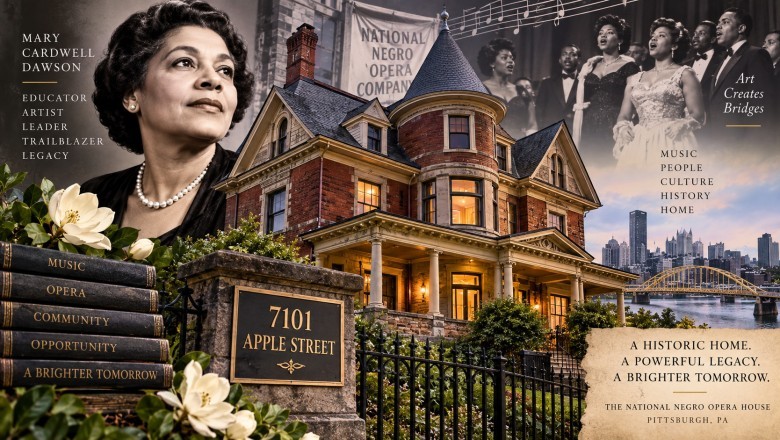
Most importantly, it became the Pittsburgh home of Mary Cardwell Dawson's pioneering National Negro Opera Company.
Today, more than 80 years after Dawson launched the company, preservationists are working to make sure the house survives to tell its extraordinary story.
A Grand House in Pittsburgh's Homewood Neighborhood
The large Queen Anne-style house stands at 7101 Apple Street in Pittsburgh's Homewood neighborhood.
Built in the late 19th century, the house eventually came into the possession of William "Woogie" Harris, a wealthy and influential figure in Pittsburgh's Black community.
Harris was the brother of celebrated photographer Charles "Teenie" Harris, whose enormous photographic archive would eventually become one of the great visual records of Black life in 20th-century Pittsburgh.
Woogie Harris had made considerable money through Pittsburgh's numbers business, an underground lottery that flourished before state lotteries became commonplace.
His Apple Street house became much more than a private residence.
It became a gathering place.
And soon, music entered the picture.
Mary Cardwell Dawson Arrives
Mary Cardwell Dawson had already established herself as one of Pittsburgh's most determined music educators.
A graduate of the New England Conservatory of Music, Dawson had returned to western Pennsylvania after discovering that America's classical music establishment offered painfully few opportunities for a Black woman hoping to build a career in opera.
Instead of abandoning music, she began teaching it.
Her successful music school eventually operated from the Apple Street house, where students received instruction in areas including voice, piano, theory, diction and performance.
Dawson wasn't merely teaching students how to sing a song or play a scale.
She was preparing them to become musicians.
By 1941, something even more ambitious was taking shape inside the house.
An Opera Company Is Born
Dawson understood the frustrating contradiction confronting Black classical singers.
They could study.
They could train.
They could master some of the most difficult music ever written.
But America's leading opera institutions still offered them few opportunities.
So Dawson created an institution of her own.
In 1941, she founded the National Negro Opera Company, using the third floor of 7101 Apple Street as office and rehearsal space.
From this house in Pittsburgh, Dawson began developing an organization that would eventually present opera in Pittsburgh, Washington, Chicago and New York.
Its first major production was Verdi's Aida, presented at Pittsburgh's Syria Mosque in August 1941.
The company would go on to perform works including Carmen, La Traviata, Il Trovatore, Faust and Clarence Cameron White's Ouanga.
Some of the Black singers associated with Dawson's company would eventually build important careers of their own.
Among them was Robert McFerrin, who later became the first Black man to sing a role at New York's Metropolitan Opera.
But the story of Apple Street extends far beyond opera.
When Hotels Wouldn't Welcome Them, Apple Street Did
During segregation, Black entertainers and athletes traveling through American cities faced a ridiculous reality.
They could perform for packed audiences and receive standing ovations — and then discover that a local hotel wouldn't give them a room.
Places such as the house on Apple Street became vital alternatives.
The house developed another identity as Mystery Manor, serving as a boarding house and social gathering place for members of the Black community and prominent visitors.
Names associated with the house's social history include singer Lena Horne, legendary bandleader Cab Calloway and heavyweight boxing champion Joe Louis.
Imagine the conversations that must have taken place inside those rooms.
Opera singers rehearsing upstairs.
Musicians coming and going.
Athletes and entertainers visiting Pittsburgh.
Students arriving for lessons.
Artists exchanging ideas in a house where they could gather with a freedom denied to them elsewhere.
7101 Apple Street wasn't simply a building.
It was part school, part rehearsal hall, part boarding house and part cultural salon.
The Opera Company Moves, but Apple Street Remains
Mary Cardwell Dawson eventually shifted much of the National Negro Opera Company's activity to Washington, D.C.
But Pittsburgh remained an important part of the organization's history.
The company continued operating for roughly two decades, providing opportunities for Black classical singers at a time when America's established opera world was only slowly beginning to dismantle its racial barriers.
When Dawson died in 1962, the National Negro Opera Company effectively died with her.
Woogie Harris died several years later.
And gradually, the extraordinary house on Apple Street became quiet.
A Historic House Nearly Disappears
Time was not kind to 7101 Apple Street.
The building deteriorated badly over the following decades. Weather, neglect and vandalism took their toll.
Yet its historical importance slowly began receiving official recognition.
A Pennsylvania historical marker commemorating the National Negro Opera Company was dedicated at the property in 1994, and the house later became a designated Pittsburgh historic landmark.
But historic recognition doesn't automatically repair a roof.
It doesn't replace rotting wood.
And it doesn't prevent a neglected building from collapsing.
By the end of the 20th century, the future of the house was uncertain.
Then Jonnet Solomon saw it.
One Woman Decides the House Is Worth Saving
Around 2000, Pittsburgh accountant Jonnet Solomon was driving through Homewood when the deteriorating mansion caught her attention.
She stopped and read the historical marker.
Solomon had never heard the story of Mary Cardwell Dawson or the National Negro Opera Company.
What she learned astonished her.
Soon afterward, Solomon and her friend Miriam White purchased the property.
What followed became another story of persistence remarkably appropriate for a building associated with Mary Cardwell Dawson.
Solomon began a decades-long campaign to save it.
The goal was never simply to repair an old house.
The larger vision was to transform the property into a cultural institution that could once again nurture artists and serve the surrounding community.
The organization now known as the National Opera House has worked toward restoring the building and returning it to active use.
One of America's Most Endangered Historic Places
By 2020, the house had deteriorated so badly that the National Trust for Historic Preservation placed it on its annual list of America's 11 Most Endangered Historic Places.
That designation brought national attention to a building whose story had been largely forgotten outside Pittsburgh and opera-history circles.
The recognition helped attract preservation partners and funding.
In May 2022, restoration officially began with a groundbreaking ceremony.
The first challenge was simply making sure the house survived.
Crews worked to stabilize the structure, and by 2024 the building had reached an important milestone: it had been stabilized.
But stabilization isn't restoration.
There was still an enormous amount of work ahead.
A Major Boost Arrives in 2026
Then came some very welcome news.
In the summer of 2026, the restoration project received a $1.75 million grant from the Mellon Foundation.
The funding provided a major boost to a project that had struggled to maintain momentum as restoration costs climbed into the millions.
The immediate goal includes permanently restoring major exterior elements of the historic house, including its roof and front porch.
The ultimate vision is much larger.
Supporters want 7101 Apple Street to become a functioning cultural and arts center — not simply a museum where visitors look backward, but a place where new artists can learn, create and perform.
In other words, they want music inside the house again.
More Than an Old House
There is something wonderfully appropriate about saving 7101 Apple Street.
Mary Cardwell Dawson spent much of her life creating opportunities where none existed.
When Black musicians couldn't find enough teachers and institutions willing to nurture them, she taught them.
When Black opera singers couldn't find enough stages willing to hire them, she created an opera company.
And when Black entertainers traveling through segregated America couldn't always find accommodations willing to welcome them, places such as Apple Street gave them somewhere to go.
Now another generation is refusing to accept that this history should simply disappear.
The walls may be old.
The wood may need replacing.
The roof may need rebuilding.
But what happened inside 7101 Apple Street cannot be reconstructed once it is gone.
That's why saving the National Negro Opera House matters.
It's not merely the preservation of a beautiful old Pittsburgh mansion.
It's the preservation of a place where Black Americans taught, rehearsed, performed, gathered and dreamed during a period when the world outside those doors routinely told them where they could and couldn't belong.
Mary Cardwell Dawson spent her career opening doors.
It seems only fitting that the doors of 7101 Apple Street should open again.