
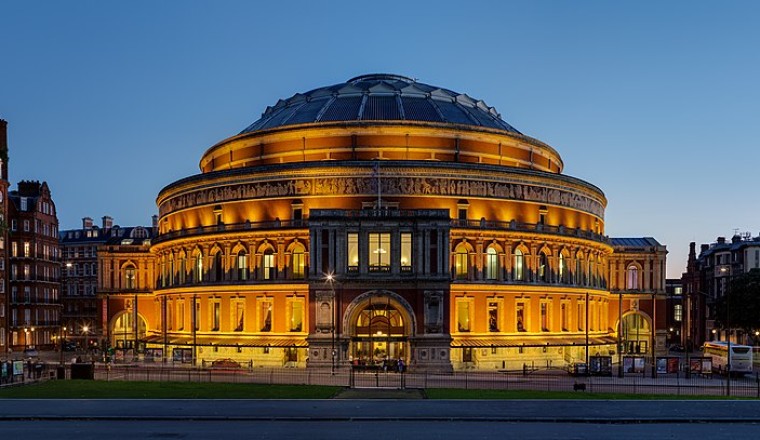

The Royal Albert Hall, located in London, is one of the United Kingdom's most iconic concert halls and in 2021 celebrated its 150th birthday.
Here's a brief history
Foundation and Design
- Inspiration: The hall was inspired by Prince Albert, consort of Queen Victoria, as part of his vision for a "cultural quarter" in South Kensington, including museums and institutions to promote the arts and sciences.
- Construction: Construction began in 1867, and the hall was officially opened by Queen Victoria on 29 March 1871. Its name honors Prince Albert, who had passed away in 1861.
- Design: The hall's distinctive circular design, often compared to a Roman amphitheater, was created by civil engineers Captain Francis Fowke and Major-General Henry Y. D. Scott. The dome was constructed by the engineering firm Lucas Brothers and is one of its most notable features.
Early Years
- The hall was initially used for exhibitions, speeches, and concerts. It became known for hosting events across a wide spectrum of disciplines, from science and engineering to music and sports.
- The building's original acoustics were problematic due to the domed roof, causing an echo. Acoustic enhancements, including the installation of the "mushroom" sound diffusers in the 1960s, significantly improved sound quality.
Significant Events
- Proms: Since 1941, the Royal Albert Hall has been the main venue for the BBC Proms, an annual summer series of classical music concerts.
- It has hosted numerous historic performances, including those by composers like Wagner and performers such as The Beatles, Adele, and Led Zeppelin.
- Non-musical events have included boxing matches, political speeches (e.g., Winston Churchill), and celebrations such as the Queen’s Jubilee events.
Modern Era
- The hall underwent significant renovations in the late 20th and early 21st centuries, enhancing accessibility, facilities, and preserving its Victorian heritage.
- Today, the Royal Albert Hall hosts over 390 events annually, ranging from classical concerts to rock shows, film screenings with live orchestras, and award ceremonies.
Cultural Icon
The Royal Albert Hall is a symbol of British culture and remains a prestigious venue for artists and audiences worldwide, representing over 150 years of history and performance excellence.
Royal Albert Hall Through Time (Animated Timeline)