
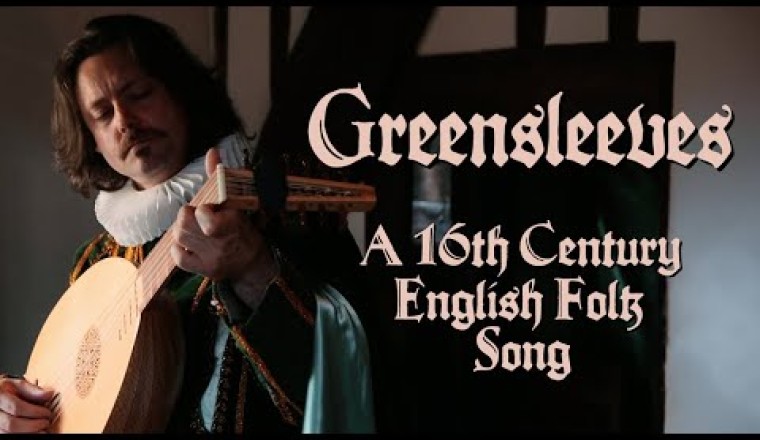

Ah, Greensleeves—that plaintive melody that floats like mist over moors, evoking love lost, chivalry abandoned, and hearts worn ragged by longing. This enduring English folk song, born in the 16th century, has bewitched listeners for over 400 years. Whether you've heard it echo from a medieval lute, woven into a Christmas carol, or sampled in pop music, Greensleeves refuses to vanish into the mists of time.
The Melody: A Renaissance Earworm
The tune of Greensleeves first appeared in 1580 when a broadside ballad titled "A Newe Northen Dittye of ye Ladye Greene Sleves" was registered with the London Stationer's Company. It was already popular enough by then to be mentioned by Shakespeare in The Merry Wives of Windsor, suggesting it was making the rounds of taverns, courts, and hearts alike.
Musically, the song is built on a ground bass that was fashionable during the Renaissance—specifically, a romanesca progression. Its haunting minor key and lilting 6/8 time give it a melancholy grace, like a sigh in musical form.
The Lyrics: A Lover’s Lament
The lyrics are written from the point of view of a rejected lover, mourning the coldness of the "Lady Greensleeves." She, it seems, has turned away despite his wealth, loyalty, and poetic wooing. Here's a taste of the original lines:
“Alas, my love, you do me wrong
To cast me off discourteously;
For I have loved you so long,
Delighting in your company.”
It’s unclear whether this is a plea, a rebuke, or a guilt-trip dressed in velvet, but either way, it’s heartfelt.
Was It Written by King Henry VIII? Not Likely.
One of the more delicious (and probably false) myths is that Greensleeves was penned by King Henry VIII for Anne Boleyn. While it makes for a juicy Tudor drama, the style of the composition—particularly the Italianate romanesca—didn’t come into vogue in England until after Henry’s reign. Still, the myth persists, and really, who doesn’t love a king with a lute and a broken heart?
A Christmas Carol? Yes, Somehow.
In the 19th century, Greensleeves got a festive makeover when its melody was paired with the carol “What Child Is This?” penned by William Chatterton Dix. The pairing gave new sacred weight to a secular lament, and it remains one of the most hauntingly beautiful hymns in the Christmas canon.
Modern Legacy: From Minstrels to Metal
This humble tune has had a surprisingly wide influence. It's been arranged for classical orchestra, interpreted by folk singers, sung by school choirs, and sampled in jazz and even metal. Artists like Loreena McKennitt, Blackmore’s Night, and Jeff Beck have taken it for a spin. And let’s not forget its role as the musical backdrop for Renaissance fairs, costume dramas, and brooding film scenes.
Why It Still Matters
Greensleeves survives because it does what great folk songs always do—it taps into something universal. Longing, rejection, beauty, mystery. It has a melody that won’t let go and lyrics that whisper across centuries, “You know this feeling. You’ve lived this.”
So the next time you hear those melancholy notes, don’t brush them off as some dusty relic. Tip your hat to the unnamed minstrel who plucked heartache from his strings and handed us a melody that still echoes in the bones of English song.