
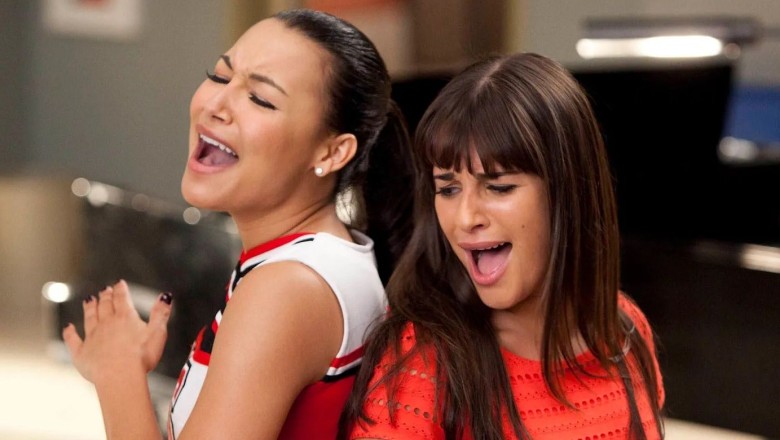

On Glee, a song could be a confession, a declaration of independence, or a beautifully sung act of aggression. “Don’t Rain on My Parade” managed to become all three. Rachel Berry, played by Lea Michele, turned the Funny Girl classic into a defining statement of her Broadway ambitions. Seasons later, Santana Lopez, played by Naya Rivera, stepped into an audition and used that same song to challenge Rachel on her own musical territory.
Same song. Two formidable voices. Enough tension to require its own intermission.
Rachel’s breakthrough performance arrives in “Sectionals,” the thirteenth episode of Season 1. After competing choirs perform numbers from New Directions’ leaked set list, the club must scramble for replacement material. Rachel answers the crisis with “Don’t Rain on My Parade,” drawing on her devotion to Barbra Streisand and a song she knows intimately. What could have been a disaster becomes an opportunity to show exactly what she can do.
The performance captures Rachel at her most compelling: ambitious, intensely prepared, and completely convinced that a stage is where she belongs. Her entrance through the auditorium makes the number feel bigger than a school competition. She seems to be marching toward the future she has imagined for herself for years.
Michele’s interpretation embraces the song’s musical-theater roots. Bright, ringing vocals, crisp diction, and emphatic phrasing give it a sense of forward motion. She builds toward the climactic passages with the determination of someone who has already pictured the standing ovation. There is vulnerability underneath that confidence, too. Rachel desperately wants recognition, and for these few minutes, her talent makes the argument for her.
The song gains a more painful association in Season 3’s “Choke.” Rachel chooses it for her NYADA audition, only to forget the lyrics and stumble again after restarting. Her musical security blanket suddenly fails her. That moment complicates its place in her story: the number represents both her extraordinary ability and the pressure she puts on herself to deliver perfection.
Rachel Berry: Season 1 Episode 13
By Season 5, Rachel has landed the role of Fanny Brice in a Broadway production of Funny Girl. Her dream is becoming real—until Santana arrives with a surprise.
In “Frenemies,” the ninth episode of the season, Santana auditions to become Rachel’s understudy. Rachel is present when Santana launches into “Don’t Rain on My Parade,” making the performance an exceptionally personal surprise. Santana wins the position, and their friendship quickly becomes a battlefield.
An important distinction is that Santana is auditioning to cover Rachel’s role, rather than competing to take the original casting away from her. An understudy is a necessary member of a production. Emotionally, however, Rachel experiences Santana’s arrival as an invasion of something she considers central to her identity.
And Santana certainly knows how to make an entrance.
Her performance recalls Rachel’s earlier staging and gestures, giving the scene the flavor of a deliberate challenge. Yet Rivera’s vocal interpretation has its own personality. The arrangement moves toward a more contemporary pop feel, and her darker, smokier tone brings a different kind of authority to the material. She bends phrases with conversational ease and adds soulful inflections that make the familiar number sound newly mischievous.
Santana: Season 5 Episode 9
Where Rachel’s version surges with theatrical urgency, Santana’s carries swagger. Rachel sounds as though every phrase is propelling her toward her destiny. Santana sounds delighted to demonstrate that she can command this room, too.
Those descriptions are interpretations, rather than a technical scorecard. Both performances demand power, control, and commitment. The pleasure comes from hearing how differently the singers shape the same material. Michele emphasizes the grand architecture of a Broadway showstopper; Rivera finds room for rhythmic freedom, vocal color, and a teasing sense of confidence.
Their rivalry makes those differences matter. Rachel has built her identity around being the future Broadway star. Santana, whose high-school relationship with Rachel included cutting insults and bullying, knows exactly where her insecurities live. By New York, they have also become friends and roommates, which makes their renewed hostility more painful.
Rachel’s fear is understandable, even when her reaction becomes possessive. Santana deserves professional opportunities, even when her approach feels provocative. The scene works because talent, jealousy, friendship, and old wounds are all sharing the stage.
So who sings it better? Rachel’s performance has the stronger claim as a defining character moment: it distills her dreams into one exhilarating number. Santana’s has the thrill of reinvention, taking a song viewers associate with Rachel and revealing how convincingly another performer can inhabit it.
Together, they demonstrate one of Glee’s greatest pleasures: a familiar song can tell a completely different story when someone else takes the microphone. Rachel makes “Don’t Rain on My Parade” a promise to herself. Santana makes it a warning that she has dreams of her own.
Both know how to stop the show.