

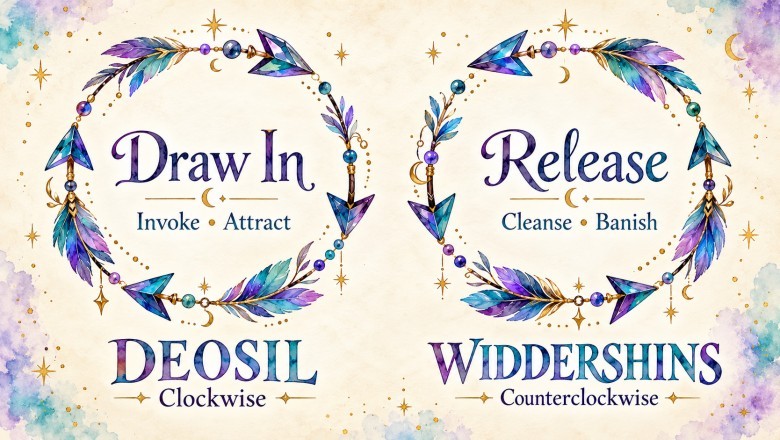

In witchcraft, even a simple movement can carry meaning. Stirring a cup of tea, tracing a circle, or moving a hand over an altar can become a way to express an intention. One of the most familiar distinctions is direction: clockwise movement is often associated with drawing something in, while counterclockwise movement is associated with releasing or removing something.
That is a useful starting point, especially in many contemporary Wiccan and eclectic witchcraft practices. However, it is a convention rather than a universal rule. Different traditions give these movements different meanings, and their spiritual significance rests within those systems of belief.
Clockwise movement is commonly called deosil, also spelled deasil. The term has Gaelic roots and is associated with moving to the right or “sunwise.” In Northern European ritual traditions, moving sunwise was often considered favorable. Many modern practitioners carry that symbolism into workings intended to encourage growth, invite blessings, or strengthen a desired quality.
For example, someone might stir a drink clockwise while focusing on confidence for the day ahead. Another practitioner might move clockwise around an altar while envisioning a protective boundary. Within this symbolic framework, the movement expresses building, gathering, or welcoming.
Counterclockwise movement is commonly called widdershins, a Scots word with Germanic roots connected to moving in a contrary or opposite direction. In many modern magical practices, it represents undoing, clearing, diminishing, or letting go.
A practitioner might use counterclockwise motions during a cleansing ritual, imagining unwanted influences leaving a space. Someone working symbolically with an unhelpful habit might trace a counterclockwise circle while naming what they want to release. The movement gives physical expression to the intention: loosen its hold, interrupt the pattern, make room for change.
This does not mean counterclockwise movement is inherently evil or dangerous. Although some historical folklore treated movement against the sun as unlucky, contemporary practitioners often use widdershins for constructive purposes. Banishing can simply mean establishing a boundary or releasing something unwanted. Clearing away and drawing in can be complementary parts of the same ritual.
Consider a working focused on a peaceful home. A practitioner following this convention might first move counterclockwise to symbolize releasing tension, then clockwise to welcome calm and harmony. Both movements serve the same overall purpose, but each expresses a different stage of the process.
Direction also appears in the creation and release of ritual circles. Some Wiccan traditions establish a circle by moving clockwise and release it through counterclockwise movement afterward. Other traditions use different procedures. Circle casting is not part of every witchcraft practice, and instructions from one system should not automatically be applied to all others.
There is also a geographical wrinkle. The association between clockwise and “sunwise” reflects a Northern Hemisphere perspective. Some Southern Hemisphere practitioners reverse their ritual directions to reflect the sun’s apparent passage across the northern part of their sky. Others retain their tradition’s established movements. Consequently, a ritual instruction that says “sunwise” may require more interpretation than one that simply says “clockwise.”
For beginners, the most helpful distinction is the purpose behind the action. Are you welcoming something, strengthening it, or encouraging its growth? Clockwise movement commonly expresses that intention. Are you releasing something, reducing its influence, or bringing a working to an end? Counterclockwise movement commonly expresses that intention.
These associations are spiritual and symbolic; they are not scientifically established properties of circular motion. There is no evidence that accidentally stirring in the opposite direction reverses your wishes or causes supernatural harm.
Within a chosen tradition, consistency can make ritual gestures more meaningful. A repeated movement becomes a familiar cue for attention and intention. Clockwise can express “I welcome.” Counterclockwise can express “I release.” The gesture gives the intention a shape—and sometimes, making space matters just as much as calling something in.
Magick Lesson: Directions