
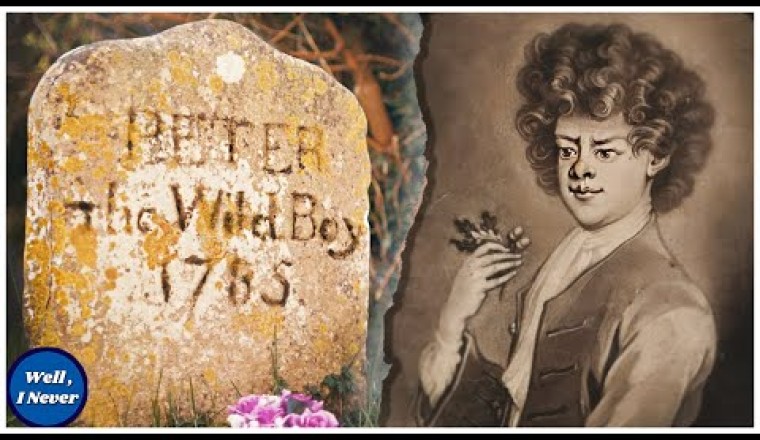

He was brought to England by King George I, who was curious about him. At the royal court, Peter became a kind of curiosity — almost like a living exhibit. Despite attempts to educate him, Peter never learned to speak more than a few simple words, and he preferred simple activities like picking pockets or playing with objects rather than formal schooling.
Later in life, he was cared for by a series of guardians in the countryside. Based on modern analysis of portraits and descriptions of him, some researchers think Peter might have had Pitt-Hopkins syndrome, a genetic condition that can cause developmental delays, distinctive facial features, and limited speech.
Peter lived a long life for his time, passing away in 1785. His story really captured the 18th-century imagination, raising all kinds of questions about nature vs. nurture, and what it means to be "civilized."
Here are some fun and unusual facts about Peter the Wild Boy:
🌿 He inspired early science fiction:
Peter’s story helped inspire debates about what separates humans from animals — questions that later influenced writers like Daniel Defoe (Robinson Crusoe) and philosophers like Jean-Jacques Rousseau. Some even say Peter was a real-life "noble savage," a popular idea at the time.
👑 He had his own personalized tag:
When Peter lived in England, they made him a special brass collar engraved with "Peter the Wild Boy" — basically an 18th-century version of an ID tag, in case he wandered off (which he did a lot).
🧩 Modern medicine solved his mystery:
It wasn’t until the 20th century that doctors suggested Peter likely had Pitt-Hopkins syndrome, which wasn’t even discovered until 1978 — almost 200 years after Peter died! This would explain his inability to speak, his facial features, and his cheerful but restless nature.
🏡 He lived out his life peacefully:
After the royal court lost interest in him, Peter was placed with a farmer's family. They gave him a quiet life in Hertfordshire. Even though he never really integrated into society the way they hoped, he seemed to live happily, cared for, and loved by the local community.
🧤 He was mischievous:
Peter was known for stealing food, snatching hats, and generally getting into trouble — but he wasn’t mean-spirited. People described him as playful and curious, more like a mischievous child than a wild animal.
Peter's story is kind of sad in some ways but also super fascinating — like he lived in a world that wasn’t quite ready to understand him yet.
Here’s a list of some other famous feral children throughout history — and honestly, some of these stories are wild (pun intended):
🌿 Victor of Aveyron (France, early 1800s)
-
Probably the most famous after Peter.
-
Found living alone in the forests of southern France.
-
A doctor named Jean Marc Gaspard Itard tried to "civilize" him — teaching him to speak and behave — but Victor only learned a few words.
-
His story inspired early psychology studies on human development (and the movie The Wild Child by François Truffaut!).
🌿 Amala and Kamala (India, 1920s)
-
Said to have been raised by wolves in the jungles of India.
-
They supposedly walked on all fours, howled, and ate raw meat.
-
Their case is controversial though — some historians think it was partly exaggerated by the missionary who found them.
🌿 Marina Chapman (Colombia, 1950s)
-
Kidnapped as a little girl and abandoned in the jungle, she claims she survived by living with capuchin monkeys for several years.
-
Later, she was rescued and ended up moving to Britain — she even wrote a book about it called The Girl With No Name!
🌿 Oxana Malaya (Ukraine, 1990s)
-
Raised by dogs after being neglected by her alcoholic parents.
-
When found, she barked, walked on all fours, and acted like a dog.
-
She later received help and learned to speak and live among humans, but some dog-like behaviors stayed with her.
🌿 Genie Wiley (USA, 1970s)
-
Not "feral" in the wild, but isolated and severely abused by her father, who kept her locked in a small room for most of her childhood.
-
Genie’s case became crucial for studies on language development and socialization.
-
Her tragic story highlighted how important early human interaction is for normal growth.
Each of these kids faced massive challenges trying to adapt to normal society again, and a lot of their stories really pushed the world to rethink what it means to be human.