

Imagine possessing the voice, training and discipline required to sing grand opera — only to discover that many of America's most prestigious stages had little interest in hiring you because you were Black.
Mary Cardwell Dawson knew that frustration firsthand.
So in 1941, she did something extraordinary.
She created her own opera company.
The National Negro Opera Company became one of the most important Black classical music organizations of the 20th century, presenting ambitious productions in major American cities and creating opportunities for Black singers who were routinely excluded from the country's established opera institutions.
Its story begins in Pittsburgh.
Mary Cardwell Dawson Had Already Built the Foundation
By the time Dawson founded the National Negro Opera Company, she had spent years preparing for the moment without necessarily knowing just how large her dream would become.
A graduate of the New England Conservatory of Music, Dawson returned to western Pennsylvania and established the Cardwell Dawson School of Music, where she trained generations of young musicians.
She also organized the Cardwell Dawson Choir and became deeply involved with the National Association of Negro Musicians, eventually serving as its president from 1939 to 1941.
Dawson saw talented Black singers all around her.
What she did not see were enough professional opportunities for them.
The solution was audacious: if existing opera companies would not provide those opportunities, she would build an organization that could.
A Historic Aida in Pittsburgh
The National Negro Opera Company was launched in 1941 during the annual convention of the National Association of Negro Musicians.
For its first major production, Dawson selected one of grand opera's biggest spectacles: Giuseppe Verdi's Aida.
The production was presented at Pittsburgh's Syria Mosque on August 29, 1941.
This wasn't a modest student recital masquerading as opera. Dawson assembled serious musical talent for an enormous undertaking.
Soprano La Julia Rhea sang Aida, while the company included performers such as Minto Cato, Carol Brice, Robert McFerrin and Lillian Evanti.
Robert McFerrin would later make history himself. In 1955, he became the first Black man to sing a role at New York's Metropolitan Opera.
Dawson was putting Black operatic talent onstage years before some of America's most prestigious institutions finally began opening their doors.
Opera Begins Traveling
The National Negro Opera Company did not remain a Pittsburgh organization.
Dawson developed a network of opera guilds in cities including Pittsburgh, Washington, New York, Chicago, Baltimore, Cleveland and Red Bank, New Jersey.
When Dawson and her husband, Walter, relocated to Washington, D.C., during the 1940s, the nation's capital became another important center of the company's operations.
Productions were eventually presented in Pittsburgh, Chicago, Washington and New York.
And Dawson was not thinking small.
The company performed in venues ranging from Pittsburgh's Syria Mosque and Chicago's Civic Opera House to Madison Square Garden in New York.
For Black singers during the era of segregation, simply appearing on these stages carried enormous significance.
Opera on a Floating Stage
Perhaps nothing better illustrates the obstacles Dawson faced — or her determination to overcome them — than the company's performances in Washington.
In 1943, the National Negro Opera Company presented Verdi's La Traviata at the Watergate along the Potomac River.
The stage was an anchored floating barge.
That unusual arrangement takes on greater meaning when placed against the racial segregation of the era. Black performers and audiences routinely encountered restrictions surrounding theaters and performance spaces.
Dawson nevertheless found ways to put opera before the public.
The 1943 La Traviata became an important success for the company, and the production subsequently reached Chicago, Pittsburgh and, in March 1944, Madison Square Garden in New York.
The message was becoming difficult to ignore.
Black singers belonged in grand opera.
The Repertoire Grew
The National Negro Opera Company tackled some of the most demanding works in the operatic repertoire.
Among the works associated with the company were:
- Verdi's Aida
- Verdi's La Traviata
- Verdi's Il Trovatore
- Bizet's Carmen
- Gounod's Faust
- Clarence Cameron White's Ouanga
- R. Nathaniel Dett's The Ordering of Moses, which Dawson adapted for operatic presentation
The inclusion of works by Black composers such as White and Dett is especially significant.
Dawson wasn't merely trying to prove that Black singers could perform the European canon.
Her organization also provided space for Black composers and Black musical expression within America's classical music culture.
An Opera Company Built Against the Odds
Producing opera is expensive under the best circumstances.
Dawson was attempting it while confronting racial discrimination, limited financial resources and an arts establishment that was not always eager to support what she was building.
Sets had to be constructed.
Costumes had to be created.
Musicians had to be hired.
Singers needed to be paid.
Venues had to be secured.
Audiences had to be attracted.
Dawson raised money, promoted performances, organized musicians, cultivated donors and handled the seemingly endless administrative work necessary to keep the company alive.
Her husband Walter Dawson also became an essential partner, serving in positions including publicity director and comptroller.
Dawson was particularly determined that her principal performers be treated as professionals. She fought to pay leading singers standard union wages even when doing so placed additional financial pressure on the organization.
This wasn't supposed to be charity.
These were professional artists, and Dawson believed they deserved to be treated accordingly.
Eleanor Roosevelt Took Notice
Dawson's work eventually attracted attention well beyond the Black musical community.
First Lady Eleanor Roosevelt supported Dawson's efforts and even personally contributed money to her work.
That recognition reflected the growing prominence of Dawson's mission.
The National Negro Opera Company wasn't simply presenting performances.
It was challenging assumptions about who belonged in American classical music.
More Than 100 Performances
From its founding in 1941 through the early 1960s, the company built a remarkable record.
Historical research indicates that the National Negro Opera Company produced roughly 110 performances between 1941 and 1961.
Think about what that represents.
Every production required money, rehearsal space, musicians, singers, costumes, transportation, promotion and venues — all while operating within a segregated society.
Dawson somehow kept the enterprise moving for approximately two decades.
The National Negro Opera Foundation
Money remained a constant struggle.
In 1950, the National Negro Opera Foundation was incorporated in Washington, D.C., to help support the company's work.
Its mission extended beyond simply financing performances. The foundation also provided scholarships to talented composers, musicians, singers and music students.
Once again, Dawson's role as an educator was never far removed from her work as an impresario.
She wasn't interested only in producing the next opera.
She wanted to create the next generation of artists.
The Company Ends, but the Story Doesn't
Mary Cardwell Dawson remained the company's director and general manager until her death on March 19, 1962.
The National Negro Opera Company effectively ended with her.
That fact alone reveals just how much of the organization depended upon Dawson's relentless energy, connections and determination.
But its influence didn't disappear.
The company had provided Black singers with professional experience and visibility during a period when opportunities in classical music were severely restricted by race.
It had staged European classics.
It had championed Black composers.
It had performed in major American cities.
And it had demonstrated, repeatedly and publicly, that the absence of Black singers from America's major opera companies had nothing to do with a lack of Black operatic talent.
The House on Apple Street
One physical reminder of Dawson's remarkable story still stands in Pittsburgh.
The Queen Anne-style house at 7101 Apple Street in Pittsburgh's Homewood neighborhood became closely connected with both Dawson's music school and the birth of the National Negro Opera Company.
Inside that house, Black musicians rehearsed, studied, planned and dreamed about stages that were not always prepared to welcome them.
Its significance today goes far beyond architecture.
It represents a chapter of American musical history that was nearly forgotten.
Mary Cardwell Dawson Built Her Own Stage
The story of the National Negro Opera Company is ultimately bigger than opera.
It's about what happens when someone refuses to accept that exclusion is permanent.
Mary Cardwell Dawson saw extraordinary Black musicians being trained for careers they might never be permitted to have. She could have spent her life complaining about those closed doors — and she would have had every reason to do so.
Instead, she built another door.
First came her music school.
Then came her choir.
Then came the National Negro Opera Company.
And eventually Black singers who had once been excluded from America's great opera houses began walking onto those stages themselves.
The National Negro Opera Company helped prove they had belonged there all along.
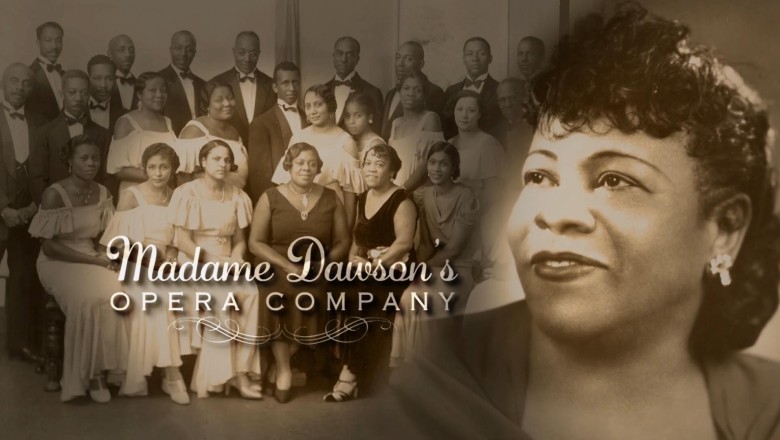
Madame Dawson's Opera Company