
Long before Mary Cardwell Dawson founded one of the most important Black opera companies in American history, she was already changing lives one music lesson at a time.
The Cardwell Dawson School of Music, also referred to in historical records as the Cardwell School of Music, was Dawson's answer to a musical world that offered talented Black performers far too few opportunities. Instead of accepting those limitations, Dawson became a teacher, organizer and institution builder, creating opportunities that the established classical music world often refused to provide.
Who Was Mary Cardwell Dawson?
Mary Lucinda Cardwell Dawson was born in Madison, North Carolina, in 1894 and grew up in the Pittsburgh area. Music became an important part of her life early, and she eventually studied at the prestigious New England Conservatory of Music in Boston.
When Dawson graduated in 1925, she was the only African American student in her graduating class. She continued her musical education with additional studies in Chicago and New York and hoped to build a professional career as an opera singer.
But the American classical music world of the 1920s offered painfully few opportunities for a Black woman with operatic ambitions.
Dawson responded by creating opportunities herself.
The Cardwell Dawson School of Music
After returning to western Pennsylvania, Dawson established her music school during the 1920s. Library of Congress records date the founding of the Cardwell School of Music to 1927 in Homestead, Pennsylvania. The school later became closely associated with Pittsburgh's Homewood neighborhood.
What Dawson created was much more than a place for occasional piano lessons.
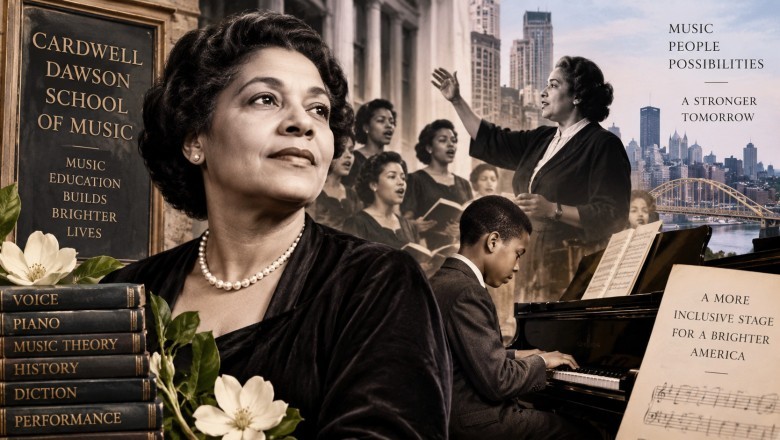
Students could receive instruction in voice and musical instruments, but the curriculum expanded to include subjects such as music theory, music history, diction, recitation, deportment and theatrical performance.
Dawson was preparing students not simply to play or sing, but to become polished performers.
Her philosophy was summed up in a saying remembered by her niece:
"The richest child is poor without a musical education."
That belief drove Dawson's work for decades.
The school developed an impressive reputation and trained hundreds of young musicians from western Pennsylvania. Dawson herself was remembered as a demanding teacher. She expected discipline, professionalism and excellence from her students — standards that would later become hallmarks of the performing organizations she directed.
A Young Ahmad Jamal Walks Through the Door
Among the school's students was a child who would eventually become one of the great figures in jazz: Ahmad Jamal.
Jamal began studying with Dawson when he was around seven years old. He would grow into an internationally celebrated pianist, composer and bandleader whose sophisticated approach to rhythm, space and dynamics influenced generations of jazz musicians.
His connection to Dawson demonstrates just how far the influence of her little Pittsburgh music school eventually traveled.
Dawson also trained and encouraged numerous singers at a time when Black classical performers could master the repertoire but still find America's major stages closed to them.
She was building a reservoir of talent.
Soon, she would give that talent somewhere to perform.
From Music Students to an Award-Winning Choir
In 1933, Dawson organized the Cardwell Dawson Choir, drawing its membership from students associated with her school.
The choir quickly developed a formidable reputation.
It presented concerts throughout the region and won the Sun-Telegraph Harvey Gaul Award for Musical Excellence in both 1937 and 1938. The ensemble's success eventually carried Dawson and her musicians beyond Pittsburgh, including appearances connected with the Chicago and New York World's Fairs.
The accomplishments of the choir demonstrated something Dawson already knew: Black classical musicians did not lack talent, training or discipline.
They lacked opportunity.
That distinction would define the next chapter of her career.
From a Music School to a Black Opera Company
In 1941, Dawson took an extraordinary step by founding the National Negro Opera Company.
The company provided Black singers with opportunities to perform grand opera at a time when racial discrimination severely restricted their access to established American opera companies.
Its inaugural production was Verdi's Aida in Pittsburgh, featuring soprano La Julia Rhea. The company eventually presented productions and performances in cities including Pittsburgh, Washington, Chicago and New York.
Dawson was no longer simply training singers.
She had helped create a stage for them.
The connection between the Cardwell Dawson School of Music and the National Negro Opera Company is especially important. Her years as an educator allowed Dawson to cultivate musicians, organize ensembles and develop the network necessary to undertake something as ambitious as a Black opera company.
The school was, in many ways, the seed from which the opera company grew.
More Than a Music Teacher
Mary Cardwell Dawson ultimately became a singer, pianist, conductor, educator, impresario and nationally recognized advocate for Black musicians.
She served as president of the National Association of Negro Musicians and continued fighting for greater opportunities for African American performers. Her work attracted attention at the highest levels of American public life, and President John F. Kennedy appointed her to the National Music Committee shortly before her death in 1962.
Yet some of Dawson's greatest influence can be traced back to the students who walked into her school looking for music lessons.
She taught them piano.
She taught them voice.
She taught them theory, diction, presentation and performance.
But perhaps more importantly, Mary Cardwell Dawson taught generations of young Black musicians that they belonged in the concert hall and on the operatic stage — whether the rest of America was ready for them or not.
The Cardwell Dawson School of Music therefore deserves to be remembered as more than a school.
It was a doorway.
And when other doors remained firmly closed, Mary Cardwell Dawson built one of her own.
Impresario, Teacher, Trailblazer
National Opera House