
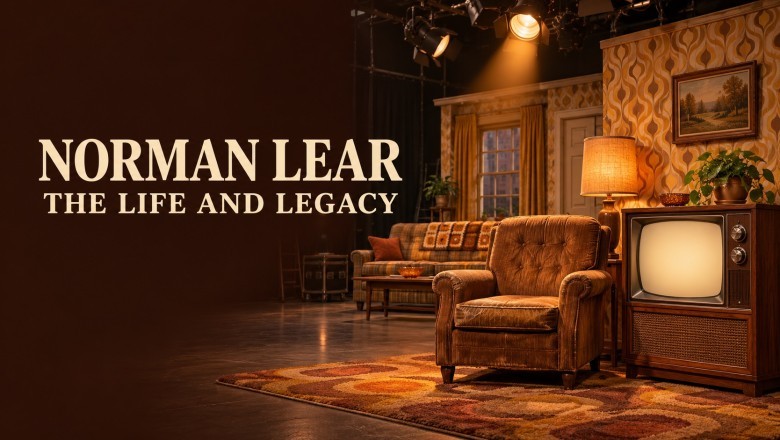

Archie Bunker’s armchair may be the most famous seat in television history. From that chair, Archie held forth on race, politics, marriage, and practically anything else that came through his front door. The trouble, for Archie anyway, was that everybody else in the house had an opinion, too. Norman Lear built a career out of letting them talk.
Born in New Haven, Connecticut, in 1922, Lear served as a radio operator and gunner aboard a B-17 during World War II. After the war, he wrote for performers including Dean Martin and Jerry Lewis and earned an Oscar nomination for co-writing Divorce American Style. His biggest break came in 1971, when he and producing partner Bud Yorkin launched All in the Family, adapted from the British sitcom Till Death Us Do Part. The arguments between Archie and his son-in-law reminded Lear of his own disagreements with his father. Soon, millions of Americans were recognizing their own families in the Bunkers’ living room.
Lear and his collaborators brought the arguments of the era into sitcom kitchens, apartments, and junkyards. The women’s movement showed up in a divorced mother’s fight for independence. The country’s arguments over race played out between neighbors and across dinner tables. A woman’s decision to have an abortion became the subject of a two-part network sitcom episode. And for all the friction, these shows were funny. A look from Louise Jefferson or a comeback from Fred Sanford could do as much work as a whole speech.
His Top 10 Sitcoms
These ten shows are ranked by their cultural impact, the social issues they took on, and what they reveal about Lear’s range as a writer, developer, and producer. You can check out episodes from all of these shows an more on his YouTube channel The Norman Lear Effect.
1. All in the Family (1971–1979)
Carroll O’Connor’s Archie Bunker was a working-class Queens man who spoke with absolute certainty on subjects he barely understood. Jean Stapleton’s Edith, Sally Struthers’s Gloria, and Rob Reiner’s Mike gave his assumptions a workout. The show took on racism, homophobia, and the divisions left by the Vietnam War. It could expose Archie’s prejudice with a single gag, as when Sammy Davis Jr. kissed him on the cheek, or let the laughter fall away, as it did when Edith faced the aftermath of an attempted rape in “Edith’s 50th Birthday.”
2. Maude (1972–1978)
Bea Arthur played Maude Findlay, Edith Bunker’s outspoken cousin, whose liberal convictions came with a healthy supply of blind spots. In the two-part “Maude’s Dilemma,” a 47-year-old Maude discovers she is pregnant and decides to have an abortion. The episodes aired in November 1972, two months before the Supreme Court’s Roe v. Wade decision. Giving Maude room to think aloud, change her mind, and make a decision turned a national debate into an intimate story about one woman’s life.
3. The Jeffersons (1975–1985)
George and Louise Jefferson moved from Queens to a Manhattan high-rise on the strength of George’s dry-cleaning business. Their success gave prime-time audiences a portrait of Black affluence, complete with arguments about class, status, and who felt entitled to belong. Their neighbors Tom and Helen Willis, a white man and a Black woman, were an interracial married couple with a regular place in the story. In 1981, Isabel Sanford became the first Black woman to win the Emmy for lead actress in a comedy series.
4. Good Times (1974–1979)
Created by Eric Monte and Mike Evans and developed by Lear, Good Times followed the Evans family in a Chicago public housing project. Esther Rolle and John Amos played parents trying to keep their family afloat through unemployment, racism, and bills that came due whether there was money or not. The fight over the show’s direction is part of its legacy. Rolle and Amos objected as more attention went to Jimmie Walker’s J.J. and his comic antics. Their objections raised a question that still matters: when a community gets a rare spot on prime-time television, who gets to decide how it is portrayed?
5. Sanford and Son (1972–1977)
Lear and Yorkin adapted the British comedy Steptoe and Son and moved its father-son junk business to Watts in Los Angeles. Redd Foxx’s Fred Sanford and Demond Wilson’s Lamont spent much of the series getting under each other’s skin, usually because Lamont wanted a life beyond the junkyard and Fred had no intention of letting him go easily. Putting a Black working-class father and son at the center of a hit sitcom gave audiences a different view of a neighborhood often defined in national news by the 1965 Watts uprising.
6. One Day at a Time (1975–1984)
Bonnie Franklin played Ann Romano, a divorced mother raising two teenage daughters in Indianapolis. Created by Whitney Blake and Allan Manings and developed by Lear, the series gave Ann the daily problems that come with starting over: finding work, paying bills, dating, and making decisions her daughters might loudly oppose. As Americans debated women’s changing roles at home and at work, Ann made independence look like something a person had to figure out day by day.
7. Mary Hartman, Mary Hartman (1976–1977)
Louise Lasser played an Ohio housewife who could fret about wax buildup on the kitchen floor while the world around her fell apart. The syndicated soap-opera parody moved from advertising promises and housework to marital trouble and mental illness, all delivered with a straight face. The joke landed on a culture that sold women the idea that a spotless floor could solve problems that a spotless floor had absolutely no business being asked to solve.
8. One Day at a Time (2017–2020)
Gloria Calderón Kellett and Mike Royce reimagined the sitcom around three generations of a Cuban American family, with Lear returning as an executive producer. Justina Machado played Penelope, an Army veteran and single mother dealing with PTSD, while Rita Moreno played her mother, Lydia. Penelope’s teenage daughter Elena comes out as a lesbian, and the family’s reactions make room for affection, conflict, and growth. The premise that made the original work still held up. A family could love one another fiercely and have plenty to learn about one another.
9. Hot l Baltimore (1975)
The missing “e” in the title came from the rundown hotel’s broken sign. Adapted from Lanford Wilson’s play, the ABC sitcom included sex workers and a gay couple among the people who called the hotel home. It lasted one season. Its place in television history comes from who got to be part of the weekly ensemble, especially at a time when recurring gay characters were rare on American network television.
10. Fernwood 2 Night (1977)
This Mary Hartman spinoff spoofed local television talk shows, with Martin Mull as preening host Barth Gimble and Fred Willard as his eager sidekick Jerry Hubbard. One episode was titled “Leisure Suits Cause Cancer,” which tells you a fair amount about the show’s approach to broadcast authority. Lear and the team understood how easily a desk, a studio audience, and a confident host could make nonsense sound official.
Lear’s civic life extended beyond television. He co-founded People for the American Way in 1981, received the National Medal of Arts in 1999, and was recognized at the Kennedy Center Honors in 2017. He died on December 5, 2023, at 101.
Decades later, you can still watch an episode of Maude or Good Times and recognize the argument before anyone finishes the first sentence. You can also hear the difference between the characters, because Lear and his collaborators gave them their own jokes, grudges, loyalties, and reasons to speak up. That’s what makes these shows worth revisiting. Everybody got a turn to talk, and sometimes the person you’d been laughing with surprised you most.
The Power of Laughter
Norman Lear: A life of laughter and activism