

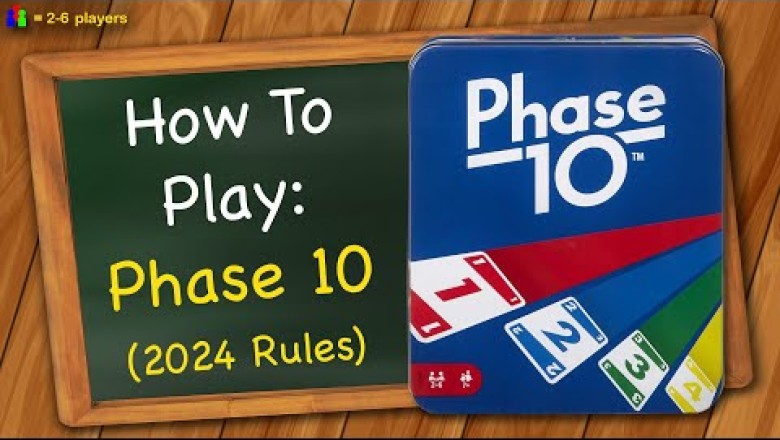

Phase 10 is a card game for 2 to 6 players where the goal changes as you go. You’ll start by collecting two sets of three matching numbers, then work your way through longer runs, cards of the same color, and bigger sets. The first player to complete all ten phases wins. If several players finish in the same round, points break the tie.
To set up, deal 10 cards to each player. Put the rest of the deck face down in the middle as the draw pile, then flip its top card face up to start the discard pile. The player to the dealer’s left goes first, and play moves clockwise.
On your turn, draw one card from either pile. If you have every card needed for your current phase, lay the whole combination face up. Once your own phase is on the table, you can add cards that fit anywhere on the table, including to another player’s phase. This is called hitting. For example, you can add a 7 to a set of 7s or a 2 to the beginning of a 3–4–5–6 run. Discard one card to end your turn if you still have cards in hand.
A set is a group of cards with the same number, such as 5–5–5. A run is a sequence of consecutive numbers, such as 3–4–5–6. Colors can be mixed in sets and runs. For Phase 8, all seven cards must share a color, and their numbers can be in any order.
| Phase | What you need |
|---|---|
| 1 | Two sets of three |
| 2 | A set of three and a four-card run |
| 3 | A set of four and a four-card run |
| 4 | A seven-card run |
| 5 | An eight-card run |
| 6 | A nine-card run |
| 7 | Two sets of four |
| 8 | Seven cards of the same color |
| 9 | A set of five and a set of two |
| 10 | A set of five and a set of three |
A Wild card can stand in for any number or color. You can use multiple Wilds in a phase as long as it contains at least one numbered card. A Skip card is played as your discard and makes a player of your choice miss their next turn. Skip cards can’t be used in a phase or picked up from the discard pile.
The round ends as soon as someone goes out by playing or discarding their last card. Everyone who laid down their phase advances to the next one when a new hand is dealt. Everyone else tries the same phase again. You can complete only one phase per round, so it’s common for players to be working on different phases at the same table.
With official scoring, cards still in your hand at the end of each round count against you. Cards numbered 1–9 are worth 5 points each, 10–12 are worth 10 each, Skips are worth 15, and Wilds are worth 25. If multiple players complete Phase 10 in the same round, the lowest total score wins. If their scores are tied, those players replay Phase 10, and the first to go out wins.
For an easy no-scoring house rule, put away the scorepad and keep track of everyone’s phase. The moment someone lays down Phase 10, they win. It’s a straight race through all ten phases.
If you're intersted and need the game there are 3 items of interest. The cards only, board for keeping score, or the all-in-one set.