

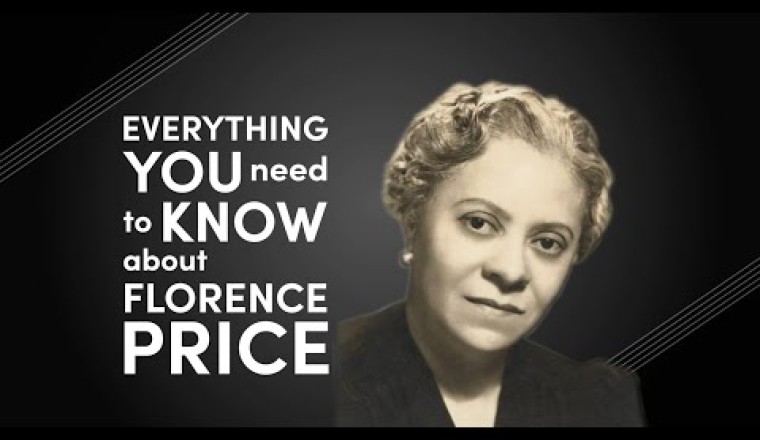

Born in 1887 in Little Rock, Arkansas, Price was a prodigious pianist and composer whose work danced between spirituals, European Romanticism, and African American folk traditions. Her music, rich in heritage and heart, remains a soaring testament to resilience, artistry, and unshakable vision.
Florence Price made history in 1933 when her Symphony in E minor was performed by the Chicago Symphony Orchestra—the first time a major American orchestra played a symphony by a Black woman. The piece, lush and majestic, was filled with melodies echoing the sorrow songs of slavery, the jubilance of folk dances, and the technical mastery of a conservatory-trained mind. It was a revolutionary moment—but one the music establishment didn't rush to repeat.
Despite her genius, Price faced dual hurdles: racism and sexism. Letters she wrote pleading for recognition—one famously addressed to Serge Koussevitzky of the Boston Symphony—contained the aching line: “I have two handicaps—those of sex and race.” But she never stopped writing. Never stopped dreaming. She composed over 300 works: symphonies, piano concertos, organ pieces, art songs, chamber music, and even spiritual arrangements that soared with soul.
Her compositions blended the sacred and the secular, the classical and the vernacular. In works like Mississippi River Suite and Piano Concerto in One Movement, you can hear the coded language of African American identity: the undulating sorrow of the Deep South, the pulse of progress, the grace of gospel. Price made concert halls ring with the sounds of Black America—long before the world was ready to listen.
And then, like many brilliant women of color, she was nearly forgotten.
Her music was lost for decades—literally. In 2009, stacks of her manuscripts were discovered in an abandoned Illinois house. It was as if her voice had been waiting patiently to be heard again. Since then, Florence Price’s legacy has experienced a phoenix-like resurgence. Orchestras, scholars, and musicians across the globe now celebrate her contributions, finally giving her work the platform it deserved nearly a century ago.
Florence Price didn’t just compose music—she composed possibility. Her life reminds us that artistry knows no boundary of race or gender, and that history, no matter how long suppressed, has a way of singing its truth again.
Symphony No.1 Finale
Florence B. Price "Adoration"
Florence Price Violin Concerto No. 2